Mans and fems splaining!

So you read about Eadweard Muybridge yesterday! Now this ‘man’ does not have to ‘explain’ it to you about today’s blog which starts with Eadweard Muybridge!

Now you also remember Rebecca Solnit from yesterday’s blog?

Rebecca Solnit had written the latest book on Eadweard Muybridge and at an event, a ‘man’ was telling him about Eadweard Muybridge!

He told her to read this new book on Eadweard Muybridge! His friends were constantly nudging him to STOP! But the ‘man’ simply carried on!

He told Rebecca that she must definitely read this new book which explains many new details!

What he did not realize is that the book about which he was ‘explaining’ to Rebecca was actually written by her!

He later on did realize it but it was too late!

After the event the Los Angeles Times published an written by Rebecca Solnit called ‘Men Explain Things to Me!’.

In it, Solnit recounts the above incident where the man repeatedly explained a “very important Muybridge book” to her, completely unaware and repeatedly ignoring the fact that she was its author, despite her friend’s attempts to inform him!

Solnit didn’t use the term “mansplaining” in the essay, but she articulated the underlying concept: the “presumption” that men’s authority and knowledge are superior to women’s, which often results in women being interrupted, doubted, and silenced!


The word “mansplaining” was coined shortly after the essay’s publication by an anonymous person in a comments section on a LiveJournal community in August 2008. Now we do not know whether is was coined by a man or a woman! Let us not explain that!

It is a blend of “man” and the colloquial “splaining” (from explaining), which already had a connotation of condescension!

The term resonated with many women who recognized the phenomenon in their own lives. It spread rapidly across feminist blogs and social media.

The New York Times declared “mansplainer” one of its words of the year in 2010.
The word was officially added to the Oxford English Dictionary in 2018, defined as a man explaining something to a woman “needlessly, overbearingly, or condescendingly, esp… in a manner thought to reveal a patronizing or chauvinistic attitude”!

The term gave a name to a behavior that many women experienced but previously had no specific vocabulary for, allowing them to better identify and challenge the underlying gender dynamics. The phenomenon itself is rooted in long-standing societal norms where men have historically been assumed to have more authority and expertise!

So men; you have some explaining to do! By the way there is another term also which you must know! Ironically not from a man like me!

That is “Femsplaining”!

“Femsplaining” is a combination of “fem” and “explaining,” used informally to describe a condescending or patronizing explanation of a topic by a woman, particularly to a man, often with an underlying assumption that he lacks knowledge!

It is patterned after “mansplaining,” but with the gender roles reversed and can also refer to a podcast or online content created by women discussing pop culture and other topics!

Like when she ‘explained’ to you that it is not blue but aqua! And she actually wanted azure and not cyan! While all these look only blue to you!

That’s the women power! Symbolized by women like Jhansi ki Rani!

Shubh ratri!

Mansplaining…

This is a two part blog!

After the apparent Men’s day; it is only fitting that the men explain! Rather let me do some mansplaining!

That is a term despised by many! Then again it is interesting about how it came about! Which will be in the blog tomorrow!

For today you must know about a book, a man and a woman author!

The book is called the River of Shadows: Eadweard Muybridge and the Technological Wild West!

As you could understand by now, the book is about Eadweard Muybridge!

Now do not worry! In spite of a bad personal life Eadweard Muybridge has actually not much to do with mansplaining!

Eadweard Muybridge (1830–1904) was a pioneering English photographer and inventor renowned for his groundbreaking work in photographic studies of motion, which was a crucial precursor to the development of motion pictures and cinematography!

The story goes as late as 1872 when Muybridge was commissioned by railroad magnate Leland Stanford to settle a popular debate about whether a galloping horse ever had all four hooves off the ground at the same time!

Through years of experimentation, Muybridge developed a system of multiple cameras triggered by tripwires to capture a sequence of instantaneous photographs that proved Stanford correct!

These images, published in works like The Horse in Motion (1878) and the massive 1887 portfolio Animal Locomotion, provided unprecedented insights into animal and human movement!

To present his findings, Muybridge invented the zoopraxiscope, a device that projected images from rotating glass discs in rapid succession, creating the illusion of motion. This early projector is considered an important predecessor to the modern cinema projector and was featured at the 1893 World’s Columbian Exposition in Chicago, effectively the world’s first commercial movie theater!

Muybridge’s extensive studies which produced over 100,000 images of humans and animals in motion deeply influenced artists, animators, and scientists alike. His work provided valuable reference material for understanding biomechanics and anatomy, and has been cited as an influence on figures like Marcel Duchamp, Edgar Degas, and even our personal favorite; Walt Disney!

Now do not worry! Once you get this information, the next part will be easy!

That was about the man and the book! The lady in question who wrote the novel about Muybridge is Rebecca Solnit! You can read about it tomorrow!

That’s suspense! What I like though are movies with lots of fun! Like MUNNA Bhai! Directed by Raju Hirani!

Wait for tomorrow but don’t lose your sleep over it!

Shubh ratri!

The Psychology of Stupidity by Jean-François Marmion

This is a great book to realize how stupid one is! Of course you will not be called stupid if you read or listen to it!

Book review!

Audiobook!

Includes many sections of stupidity, assholes and the future of stupidity!

It is a fun ride!

The book is actually a translated book from French! Of course it is about stupidity! 

One of bias discussed in the book is called the Dunning-Kruger effect.

The Dunning-Kruger effect is a cognitive bias where people with low ability in a specific skill tend to overestimate their own competence, while high performers often underestimate theirs!

The book also explores why people, including intelligent individuals, act in ways that are irrational or counterproductive, often involving a refusal to engage in critical thinking or an unwillingness to question their own biases. 

Key concepts in the psychology of stupidity which cater to these and other biases include:

Cognitive Biases: Stupidity often stems from inherent human cognitive biases and mental shortcuts (heuristics) that lead to errors in judgment. 

Confirmation Bias: Favoring information that confirms existing beliefs while ignoring evidence to the contrary.

Overconfidence Effect: Overrating one’s own abilities, knowledge, and the accuracy of one’s beliefs.

Availability Heuristic: Relying on information that comes to mind easily and quickly, rather than seeking more comprehensive data. The point about Heuristics is elaborated more in the book and in this review!

The “Stupidity Paradox”: This describes how even highly educated workers may engage in “functional stupidity”—an inability or unwillingness to use their reflective capacities in the workplace, often due to strict adherence to organizational norms and thinking “inside the box”. 

Here the author has given examples of supposedly intelligent people like even Bill Clinton and his fiasco at the time he was at the most coveted position in the world!

The psychology of stupidity suggests it is not merely a lack of intelligence, but a willful refusal to think critically, examine consequences, or embrace new ideas. It is often an outcome of cognitive biases, emotional influences, and social pressures that affect even smart people at times. 

Another point the author makes is about Ego and Arrogance since a strong ego and lack of self-doubt can lead individuals to stubbornly cling to opinions and reject correction or self-awareness!

Also when she describes stupid ‘assholes’ she points out that there is an obvious lack of empathy and a reduced concern for others’ feelings or perspectives which is associated with more foolish behavior.

People may carry out harmful or irrational actions when instructed by an authority figure, abdicating personal responsibility.

There is also a information Overload & Short Attention Span which can overwhelm cognitive abilities, making people more susceptible to manipulation and simplistic narratives!

There is a whole section with q and a on why Trum$ is an a4s%%%! Luckily he may not read this book!

There is also section of interview with Daniel Kahneman and his book where they explain how because of two systems, people tend to do stupid things!

Here you get to know about heuristics!

Daniel Kahneman, a Nobel laureate in economics, demonstrated that human decision-making often relies on mental shortcuts called heuristics, which can lead to systematic errors in judgment (which can appear as a form of “stupidity”). 

His work, primarily with Amos Tversky, challenges the traditional assumption that humans are rational agents. 

Kahneman’s research established that people use heuristics, or “rules of thumb,” to make quick decisions and save mental effort. While these shortcuts are often efficient, they are not flawless and can result in predictable mistakes, or cognitive biases.

In his bestseller Thinking, Fast and Slow, Kahneman introduced a dual-process model of the brain.

System 1 is fast, automatic, intuitive, and emotional, operating with little or no effort. It is the source of heuristic-driven judgments.

System 2 is slower, more deliberate, analytical, and logical, requiring attention and effortful mental activity.

“Stupidity” often arises when System 1 overrides System 2, leading to quick but incorrect judgments, even when the person is highly intelligent in other contexts. The brain is a “machine for jumping to conclusions” and often endorses the suggestions of System 1 without sufficient scrutiny by System 2.

This interplay of the systems can make even non stupid people act stupidly!

There is a whole section on how being a meat eater is being very stupid with lots of pointers too! At least I am not a stupid of that kind!

All in all a very good book on how not to be stupid! How not to press the already pressed elevator button! Why you should not check your watch five minutes after you just checked it! How you can be ignorant but still be ok but do not be stupid! Like the politician who actually does not understand stuff but wants to rule! How you can show empathy not only to your pets but to other animals as well!

There are many quotes attributed to Einstein in the book which are so cool and well, not stupid! One is that Two things are infinite; the universe and Human stupidity! And I am not sure about the Universe!

Another one is Genius and stupidity are two similar human traits but genius has limits!

These two are some of the best quotes on stupidity which the author makes all through the novel! It is funny and serious at the same time!

Another section states that you can be stupid once in a while and you will be! But what you do after the fact makes you either an a@@ or not! Apologize! In this the author specifically states that it should be heartfelt and real! Furthermore it is up to the person who is receiving the apology to forgive you or not! Do not be a stupid a## and make a half baked apology!

If you do not want to be stupid of course! Then again if you are at least reading this summary or the book, you may not be one!

Men’s cross wor$!

Do you know this joke?
A crossword enthusiast was sent to hell! There he saw countless books full of; well Crosswords!

He was so happy!

What is the big fear of hell he thought to himself!

Then he took one crossword book and went to the old ‘hell’ librarian and asked for a pencil.

The old librarian gave an impish smile and said, “That is the HELL of it my friend! NO PENCILS!”

I used to love the Cryptic crosswords of the Hindu but do not have access to them or much time for them nowadays since you do not feel satisfied if you cannot solve them completely!

So the NYT quick crossword is the solution now! It is fun and fast!

In the men’s hostel in our medical college, we used to wait till 11 am to cut the crossword and run to solve it! It used to be fun!

Now did you know that the very famous word crossword is actually a typo!

So the story goes on how the modern crossword puzzle was invented by Arthur Wynne!

Wynne published the first “Word-Cross” in the New York World newspaper on December 21, 1913. It became a popular craze in the 1920s, leading to the first crossword puzzle book!
Wynne was inspired by an old word game called word squares!


The name “crossword” was an accidental result of a typographical error, originally intended to be “word-cross”!


After the first few months the puzzle’s popularity explodes, leading to a “crossword craze” with crossword-patterned stockings, musicals, and comic strips!

Simon & Schuster publishes the first book of crossword puzzles, which becomes a major success and helps establish the genre!

One of the most popular puzzles in the world is the NYT!

This was actually done by NYT for fun and reduce stress from war!

The New York Times begins publishing crossword puzzles, prompted by World War II, as a way to provide a distraction from the war news.

The best puzzles are actually the cryptic ones which were in Britain, featuring complex clues that require wordplay and lateral thinking!

The then Prime Minister, Stanley Baldwin, was known to enjoy doing crosswords, as does the Queen – whose cipher ER is a frequent allusion in cryptic clues. By the 1930s cryptic crosswords had become more sophisticated in design: clues can be full or partial anagrams, double meanings and clues leading to further words!

If you thought is was simply fun, solving crosswords can actually strengthen short-term memory and long-term recall by forcing you to retrieve information and link concepts!

They also enhance analytical thinking, pattern recognition, and logical reasoning, skills that can be applied to everyday problems!

The act of solving clues requires focus and can improve your ability to concentrate on other tasks! Regular solving keeps the mind sharp and may help delay cognitive decline by engaging multiple brain regions!

It also provides a mental break from daily pressures and can be a relaxing and stress-reducing activity!

The satisfaction of solving clues and completing a puzzle can boost confidence and provide a sense of accomplishment! It has also been shown to increase dopamine production, which can improve your mood!

While doing all this you can also learn new words and can help you become more fluent in communication! Just like reading books this can also be an effective way for reinforcing knowledge in various subjects, helping to identify and fill gaps in understanding!

Just do not end up in hell with no pencil though!

Then again today is not world crossword day but apparently world men’s day! Which is ridiculous since I would like to see what a ‘man’ would do alone! But to keep the fun, which man can be reflective of a ‘man’ other than HANUMAN! For us though Hanuman played by Dara Singh ji would always be the top!

Now both ‘men’ and ‘women’ do sleep! Days will come and go! Work will always be needed to be done by both!

Shubh Ratri!

What’s your age!?


The novel Ayodhya Alliance tells us about this amazing technology in ancient times where the metal was made with a secret process which made sure that the iron remains rust and corrosion free for ages! A feat even difficult now with modern methods!

Iron was one of the foremost metal to deal with! It was the pride of the Iron age!

But did you know that even the classification was actually created by a intern without any knowledge of either history or metallurgy!?

The story goes that the Danish country in an attempt to uplift the country image wanted to build a museum and so collected artifacts all over the country and dumped them in a big room!

C. J. Thomsen an unpaid intern with no knowledge of archaeology was given the task of organizing them!

After one year of breaking his head he divided them into stone, bronze and iron! Little did he know that he accidentally stumbled upon the classification which historian use to this day! The stone, bronze and the iron age!

Thomsen, a Danish antiquarian and the first curator of the National Museum of Denmark, developed this system in the early 19th century while cataloging the museum’s large collection of artifacts.

He observed that artifacts made of stone consistently appeared in the oldest contexts, followed by those of bronze, and finally those of iron, demonstrating a progression in technological development!

The classification is based on the dominant material used for weapons and cutting implements during each period:

Stone Age: A period when tools and weapons were primarily made of stone, wood, bone, or similar materials, and knowledge of metals was very limited or absent.

Bronze Age: A subsequent period characterized by the use of bronze (a copper/tin alloy) for tools and weapons, with little to no knowledge of iron.

Iron Age: The most recent prehistoric period, where iron was widely used for the articles for which it was suited, superseding bronze!

Thomsen’s system was revolutionary because it established a scientific basis for the relative dating of prehistory, which had previously relied heavily on mythological or textual sources@

His methods, which included the study of associations between artifacts in “closed finds” (artifacts found together in the same layer or grave), allowed for a systematic and evidence-based ordering of the past@

The principles of Thomsen’s classification were published in his influential 1836 book, Ledetraad til Nordisk Oldkyndighed (A Guide to Northern Antiquities!)
The book was not in English!

The classification system has actually been mentioned couple of fmaous novels like the in the novel A Journey to the Center of the Earth (French: Voyage au centre de la Terre) by Jules Verne! Even that was originally written in French!

This proves that knowledge is not limited to one language! Also proving that just because someone is good in English does not make him or her ‘knowledgeable’!

The system provided a foundational structure that remains the basis for much of the Old World’s prehistoric chronology, though it has since been refined with further subdivisions (such as the Palaeolithic and Neolithic periods within the Stone Age)!

The end summary without digressing though is that just because you are a lowly paid intern working on a job of which you have no idea, does not mean that it is the end of the world! You can still make history!

Historical also were movies made by V Shantharam!

Shubh ratri!

Brooding or mouthbrooding!

You get upset about something and then you start Brooding! That is sad and well, your right! There is another brooding which is, well a duty and in fact a supreme sacrifice!

That is called the Mouthbrooding!

The phenomenon was thought to have evolved from a lack of nest sites or habitat invasion and predation.

Mouthbrooding is in fact a reproductive or more accurately a rearing strategy where a parent animal holds its eggs and young in its mouth for protection and incubation until they are ready to survive on their own!

This behavior is most commonly seen in fish, where either the male or female, or both, will hold the eggs in their mouth, but it is also found in some other animals like the Darwin’s frog.

This method is a significant investment for the parent, often preventing them from eating during the brooding period!

The primary purpose is to protect the eggs and hatched young from predators and environmental dangers. The parent keeps the eggs in their mouth, mixing them to ensure proper oxygenation and prevent them from sticking together.

You must understand the supreme sacrifice here!

The parent is typically unable to feed during this time, a considerable sacrifice that can also lead to a build-up of waste chemicals in their system! The point to note is that the role of the mouthbrooder can be taken on by the male, the female, or both, depending on the species.

The parent may gently mix or “tumble” the eggs in their mouth to ensure proper oxygen flow and prevent fungal growth!

In many cases, the parent will continue to protect the mobile fry (young fish) after they hatch, allowing them to swim out to feed and dart back into the parent’s mouth when danger is near! Just like the pouch of a Kangaroo!

Just when you thought you are a good parent! You learn about Mouthbrooding! Now dont go Brooding!

Good of course was actor Shriram Lagoo!
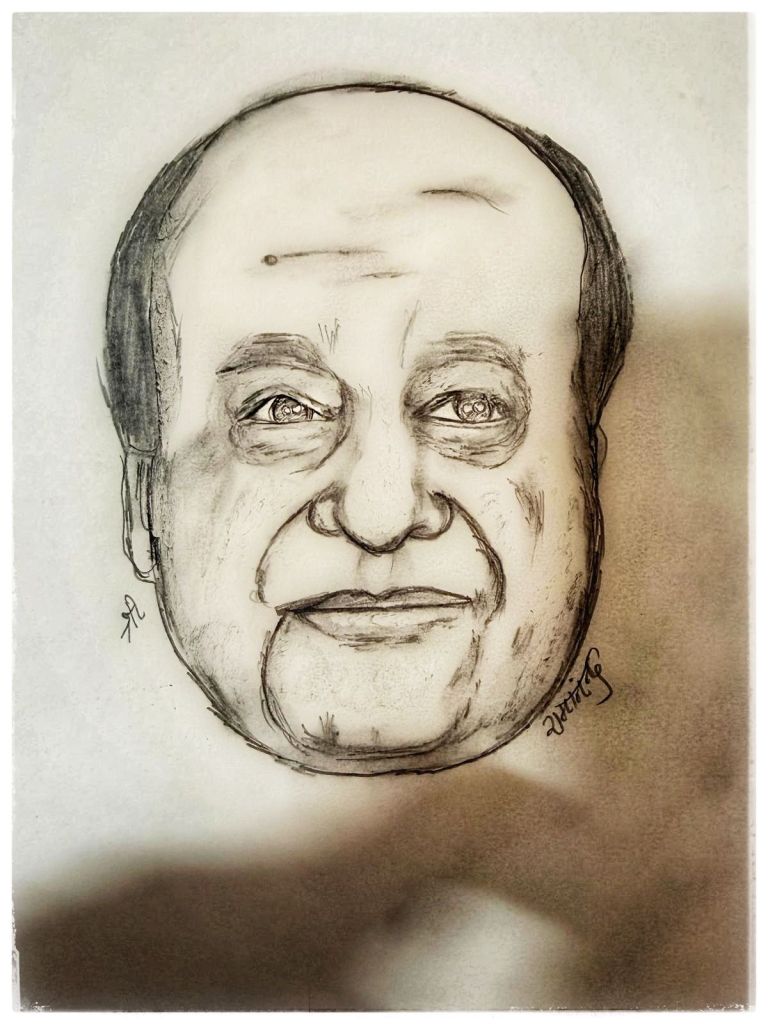
One of the few sketches where both the person who sketches and the one he sketches are the same!

Shubh ratri!

Clever hans

A book called ‘How to talk anyone; 92 little tricks for big success in relationship’ by Leil Lowndes apart from pretty interesting tricks tells the story of clever Hans!

Apparently Hans could do addition, subtraction and even division and multiplication! Later of Hans even knew languages!

What’s so great about that you say!? Now if Hans was a two year old kid it would be amazing!

But he was actually much more!

Well, Hans was a horse!

Clever Hans was a horse in early 20th-century Germany who appeared to perform mathematical and intellectual tasks!

It was of course a great trick in response to subtle cues! So much so that it is now a well known phenomenon called the Clever Hans effect and serves as a famous cautionary tale in psychology and scientific research!

So Hans was owned by Wilhelm von Osten, a high school mathematics teacher who believed that animals had underestimated intelligence!

From around 1891, von Osten trained Hans to answer questions by tapping his hoof or using a letter board. Questions could be asked orally or in writing, and Hans’s apparent abilities included addition, subtraction, multiplication, division, telling time, and reading/spelling German words!


Hans’s performances were a public sensation, drawing large, enthusiastic crowds across Germany. A commission of experts, including a circus manager and the director of the Berlin Zoo, initially concluded that no tricks were involved!

Then some more research lead by psychologist Oskar Pfungst lead to some crucial discoveries in 1907!

Hans’s accuracy dropped significantly if the person asking the question did not know the answer themselves!
The horse struggled to respond correctly if the questioner was out of sight or completely still!

Pfungst concluded that Hans was not performing mental tasks but was incredibly adept at reading microscopic changes in the questioner’s posture, breathing, and facial tension. When Hans reached the correct number of taps, the human would subtly change their expression or movement, which cued the horse to stop!

These cues were entirely involuntary and unconscious on the part of the humans involved!

So Hans was clever! But not ‘internally’ clever but a clever Mentalist! That is still special and rare by the way!

The “Clever Hans effect” now describes the phenomenon where a subject unintentionally receives and responds to subtle cues from an experimenter or questioner, thereby appearing to demonstrate abilities they do not possess!

This has had a lasting impact on scientific methodology, leading to the use of “double-blind” experiments in fields such as psychology and medicine to avoid research bias!

The Clever Hans effect remains relevant today, particularly in fields like artificial intelligence (AI). It is used to describe when a machine learning model appears to perform well but is actually relying on “shortcuts” or spurious correlations in the data rather than true understanding of the task at hand!

What happened to Hans?
Well, apparently and sadly it was sent to war and could have been killed or eaten by soldiers!

Unfortunately a clever animal is still apparently an animal…

Humans can act humane though! And really talented! Like Kamini Kaushal!

She will be missed

Om Shanti…

Jam study!

When you are in a Jam then it is difficult to get out! Traffic or anything else!

Then again there is a study on JAM that may help you!

The study is simply called the Jam Study!

This is presented and done by an author called Sheena Iyengar in her book; The Art of Choosing!

Have you often gone to an amazingly Huge buffet and always felt that whatever you take, you could have taken something else! Or that you could not do justice in any case!

It is the paradox of choice! Too many options actually spoil the fun! You would rather have some limited choices and enjoy them all!

So the Jam study took place in an upscale grocery store (Draeger’s) in Menlo Park, California, a store already known for its extensive product variety (e.g., 250 types of mustard), so an abundant display would not seem unusual to shoppers.

A tasting booth was set up, rotating between two conditions every few hours:

The first was the limited choice option where the shoppers were presented with a selection of 6 different varieties of an exotic brand of jam.

In the next, there was an extensive choice option in which shoppers were presented with a selection of 24 different varieties of the same brand of jam!

The results starkly illustrated the “paradox of choice” since it was found that the shoppers in the limited-choice condition were ten times more likely to make a purchase than those in the extensive-choice condition!

The “jam study” provided empirical evidence that an abundance of choices can have negative psychological impacts!

In fact when shoppers were offered 24 varieties of jam, only 3% made a purchase. However, when the selection was limited to 6 varieties, 30% bought jam!
This demonstrated that an abundance of options can attract initial interest but ultimately deter decision-making!

The issue is of being overwhelmed! An excessive number of choices can lead to a state of anxiety and an inability to make a decision at all. Even if a choice is made, individuals may experience greater regret, wondering if a different, unchosen option would have been better, which diminishes satisfaction with their final decision!

It has of course been emphasized that there are cultural Influence and the desire for and perception of choice are not universal. Western cultures tend to prioritize individual autonomy and extensive choice, while other cultures may view choices through the lens of group consensus and social harmony, sometimes preferring to defer decisions to experts or family.

But the fact of the matter is that shoppers who bought jam from the 6-item display reported greater satisfaction with their choice, perhaps because it was easier to feel confident they had considered all the options and made a good decision!

In essence, the study challenges the assumption that more choice is always better, suggesting that finding the right balance and understanding the psychological and cultural factors at play is crucial for making effective and satisfying decision!

Satisfying and an amazing life also was lived by Saalumarada Thimmakka! She will be missed but an sure she will be welcomed in heaven!

Om Shanti…

Lactose free human!


So do you like to drink milk? Hope you are not lactose intolerant!

If you are then you are actually more ‘human!’

Yes! Our ancestors were like you or rather you are more similar to them! Now I am not calling you ‘old’ but being lactose intolerant is actually more ‘normal’!

This is not milk allergy though! The lactose intolerance is due to the carb while the allergy is due to the protein!

Remember how your mother always told you to drink that ‘milk’ everyday!? The ancient humans also did that to get more calcium!

In the book called Humans are not from Earth (or something like that!) by Dr Ellis Silver he states that our workaround for getting more calcium is to drink cow’s milk and eat dairy products!

Since cow’s milk isn’t part of our natural diet, there was a time when none of us could even tolerate it. We were all lactose intolerant, and it would have given us stomach cramps and made us feel ill.

Even so, our ancestors persevered – the pain and nausea were still somehow better than the alternatives! Thanks to them, we evolved the ability to tolerate lactose, and most of us can now consume it without any problems!

But the fact remained that being lactose intolerant was normal for ancient humans, as it is the ancestral human state. The vast majority of people were lactose intolerant before the evolution of a genetic mutation called lactase persistence, which arose in populations that domesticated dairy animals around 10,000 years ago!

For most of human history, all humans stopped producing the enzyme lactase after weaning, making them unable to digest the lactose in milk.

In fact lactose tolerance is a relatively recent evolutionary development that emerged in some populations as an adaptation to a diet that included dairy products.

The genetic mutation for lactase persistence became common relatively quickly in some regions, likely driven by extreme conditions like famines and epidemics that made dairy a valuable source of nutrition.

This was also the reasons for the ancient people to process the milk to curd or other milk products which are more easy to digest!

Of course, there’s still a significant number who can’t. We tend to call them “lactose intolerant” as if there was something wrong with them, but really, they’re just normal!

So it’s the rest of us who are strange and not the other way around! So remember that all were brothers once! Lactose or not!

The original lactose intolerant ones are the real descendants of the ancient humans while the ‘tolerant’ ones are the genetically ‘modified’ hybrids! Remember that the next time you are ‘intolerant’ to the ‘intolerants!’

Of course you can tolerate legendary freedom fighters like Krantiveera Sangolli Rayanna!

Shubh ratri…

Fast or slow or stupid!?


The Psychology of Stupidity take a leaf out of the famous book by Daniel Kahneman called Thinking; fast and Slow.

There is actually an interview of sorts in the book with Daniel!

This is important since if you think that only idiots are stupid well, you are stupid, I mean wrong!

The famous situation when you are driving on a highway and according to you, anyone driving slower that you is an idiot while anyone driving faster than you is a maniac!

We check our watch for time (the minority who still have a watch for time and not the phone!) and just five minutes later check it again! According to the author, that is actually a stupid behavior since it does not make any sense!

But you must remember that many so called ‘intelligent’ people do act ‘stupid’ once in a while and the author states how it could be due to the ‘two systems’ in the brain!

Kahneman, is of course a Nobel Prize-winning psychologist, is renowned for his research (much of it with his late collaborator Amos Tversky) into the psychology of judgment and decision-makin and his key contributions explain “stupidity” not as a lack of intelligence, but as a result of inherent flaws in human thinking!

Kahneman’s work introduced the idea that people have two systems of thought:

System 1 (Fast, Intuitive): This system is quick, automatic, and relies on mental shortcuts (heuristics). It is prone to systematic errors, or cognitive biases.

System 2 (Slow, Deliberative): This system is more effortful, logical, and analytical. While more accurate, people often defer to System 1 to save mental energy.

In short it is the system 1 which is fast but ‘stupid’ while system 2 is ‘not so stupid!’

These leads to some biases and errors!

One of this is the cognitive Biases: These are systematic errors in thinking that affect judgment and decision-making.

One of the reasons for going stupid is getting Overconfident! People often overestimate their own abilities and knowledge, leading to poor decisions.

In his later work, Kahneman explored “noise,” or the unwanted variability in human judgments that should be identical, highlighting how even experts can be inconsistent in their decision-making!

Stupidity from ‘normally intelligent’ people thus is dependent on social pressures, emotional factors, and cognitive biases which overrides logic, causing otherwise intelligent people to act foolishly.

The author states that stupidity isn’t a fixed trait but a behavioral tendency we all exhibit at times, which can be compounded by factors like groupthink and media manipulation!

Yes! If you thought that thinking in a group or with a group increases your intelligence or productivity, well then you are let us just say not that intelligent! But that is a subject for some other day!

For now; if you think you are not that stupid then try to use the ‘system 2’ as much as possible!

System 2 also is the one which brings out your talent to the front! Like the super talented Pulapaka Suseela!

Shubh ratri…