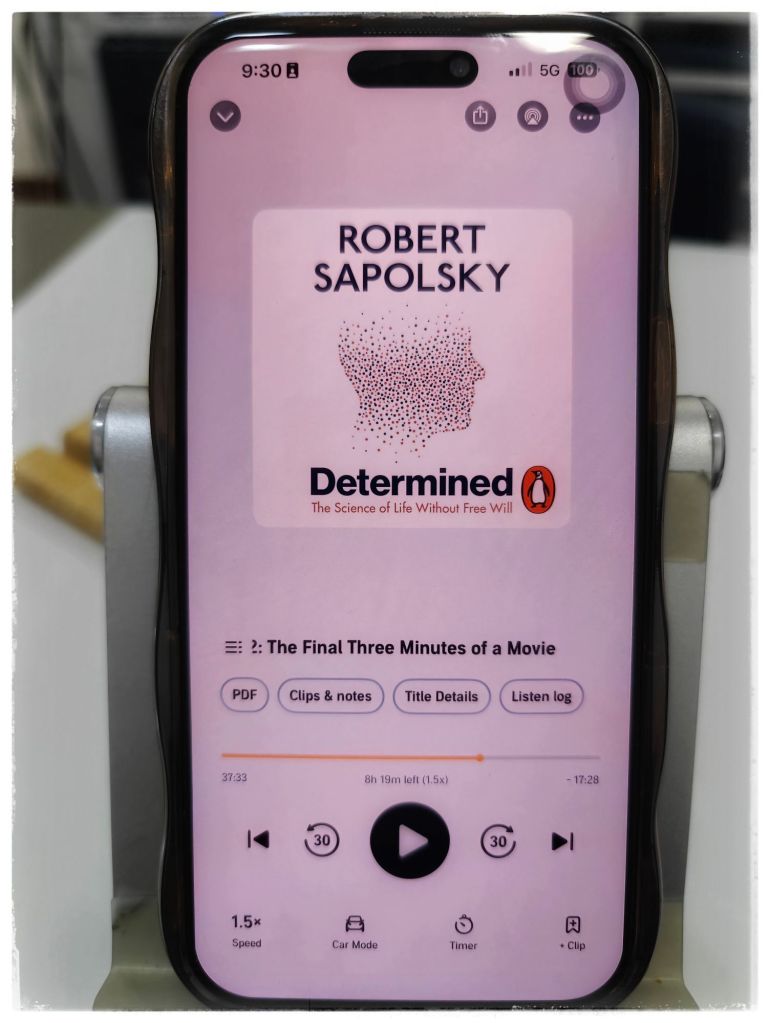
Determined by Robert Sapolsky
Audiobook
Book Review
A LONG veritable summary of the book to get the essence!
The author is also the author of the book; Behave: The Biology of Humans at Our Best and Worst (2017) which is a comprehensive exploration of why humans act the way they do, from acts of extreme violence to incredible kindness.
Behave was the book I listened before this and of course you have overlaps!
They both are different though but it is better to read or listen to Behave first or at least read my blog which summarizes the novel.
According to neuroscientist Robert Sapolsky, every human action is entirely determined by a seamless chain of biological and environmental factors, leaving no room for free will.
Sapolsky argues that behavior cannot be explained by a single cause. Instead, he analyzes it through a reverse-chronological lens:
One Second Before: The brain’s immediate reaction, specifically the conflict between the emotional amygdala (fear/aggression) and the rational prefrontal cortex (logic/self-control).
Seconds to Minutes Before: Sensory cues in the environment, such as a person’s facial expression or even the presence of certain smells.
Hours to Days Before: Hormonal influences, such as testosterone (which amplifies status-seeking rather than just aggression) or oxytocin (which increases in-group bonding but can fuel out-group hostility).
Weeks to Decades Before: Childhood and adolescent experiences, where brain architecture is wired based on environment and stress levels.
Centuries to Millennia Before: Cultural, geographical, and evolutionary factors that shaped the genetic predispositions of a society!
Robert Sapolsky tells about free will and how most do not have it!
In all of these he uses various scientific paper starting from the famous turtle joke!
The story goes like this;
William James was an American philosopher and psychologist and once after explaining the Earth orbits the sun, an elderly lady tells James the world rests on a turtle!
James then politely asks a woman what the earth stands on after she claims it rests on a turtle! She replies, “on another turtle,” and when pressed, concludes, “It’s no use, Mr. James, it’s turtles all the way down!”.
The story highlights the concept of infinite regress—the failure to find a foundational, ultimate cause!
The chief emphasis is on a study which questioned free will in the first place. This study has been detailed and modifications have been mentioned many times in the novel.
The Libet experiment found that unconscious brain activity, known as “readiness potential” (RP), begins ~500 milliseconds before a person consciously decides to move. This suggests the brain initiates actions before the conscious mind is aware of the decision, challenging traditional notions of free will and suggesting consciousness reports on actions rather than causing them!
Robert states this tests and argues for the lack of free will adding the fact that the modifications of the tests also show similar finding.
Then you have some more summaries and findings as in the novel
Us vs. Them: Our brains are hardwired to categorize people into “in-groups” and “out-groups” almost instantaneously, but these categories are flexible and can be changed through exposure and reframing.
Sapolsky argues that as we learn more about the biological determinants of behavior, the space for traditional “free will” shrinks, which he suggests should lead to a more compassionate and less punitive justice system.
The same hormone or brain region can produce opposite behaviors depending on the situation (e.g., oxytocin can make you kinder to your “Us” but meaner to a “Them”
Then there was interesting point about Doctors!
Are you planning for an emergency surgery!?
Just make sure that it is not the Surgeon’s birthday!
Of course, when we go for a Surgery, we think and plan and discuss a lot of things!
But when it comes to Emergency, there is no time! One thing you may need to find out is the lead Surgeon’s birthdate!
Robert Sapolsky here mentions this interesting information!
Apparently studies show a 23% higher mortality rate for emergency surgeries performed on a surgeon’s birthday compared to other days!
This is thought to be due to distractions from birthday celebrations, causing surgeons to rush or be less attentive, particularly affecting elderly patients undergoing emergency procedures!
The Surgeon also may make decisions which leads to faster outcome, but not the ideal outcome. This means that the Surgeon may try to finish the case earlier and may not select the best protocol, but fastest!
A key finding on Surgeon’s Birthday vs. Normal Days is that Patients are more likely to have complications within 30 days if their emergency surgery is done on their surgeon’s birthday. The likely causes included distractions from personal plans, birthday messages, or potential reduced care following the procedure!
Remember that the elevated risk was observed for emergency surgeries, but not for elective (scheduled) procedures. The Studies though primarily analyzed older Medicare patients.
Even doing the surgery is not freewill you see!
Then you have an interesting point about ants!
This needs more explanation!
Robert among other things, talks about how ants get food!
Actually, the numbers would shock you! Depending on the size of an average and colony, it would take 360,000 ways if there are 10 sites to get food.!
Do you know what happen if there are 15 sites!?
There is at least 80 billion ways of getting the food!
So how do ants get it?
They do and very effectively in fact! When this is used to solve problems it is called swarm or ant optimisation!
Ant Colony Optimization (ACO) is a nature-inspired metaheuristic algorithm used to solve complex computational problems by finding optimal paths through graphs.
It was introduced by Marco Dorigo in the early 1990s and is a key part of the broader field of swarm intelligence.
The algorithm mimics the foraging behavior of real ant colonies. When searching for food, ants initially wander randomly. Once food is found, they return to their nest while depositing a chemical substance called pheromone on the ground.
Other ants are attracted to these trails. Shorter paths allow ants to return faster, leading to a quicker buildup of pheromones, which in turn attracts more ants.
Over time, the pheromone trails evaporate. This “forgetting” mechanism prevents the colony from getting stuck on a single suboptimal path and encourages the discovery of new, potentially better route!
ACO translates these biological behaviors into a computational framework using “artificial ants”.
This actually has many common applications!
Like the Traveling Salesman Problem (TSP)! one can use Ant Colony Optimization (ACO) to find the shortest route to visit multiple cities and return home!
We can also use it for Network Routing by Optimizing data traffic and identifying the fastest paths in communication networks!
Another area is for Scheduling! You can assign tasks or resources efficiently (e.g., job-shop or hospital scheduling).
The Ant Colony Optimization (ACO) can also be used for vehicle Routing and to determine the best paths for a fleet of delivery vehicles!
See what a colony of ants can do? They can make sure your Amazon prime delivery comes on time!
Then you have this interesting ‘fact’ about judges! I have actually read the same in his earlier book and several other non fictions!
In this though Robert Sapolsky mentions the famous study on judicial decisions.
The study known as the ‘lunchtime effect’ is a 2011 study on judicial decision-making (often referred to in behavioral economics), there is a significant, albeit unintentional, relationship between the timing of a bail hearing and the likelihood of bail being granted!
The Research indicates that judges are more likely to grant parole or bail at the beginning of the workday or immediately after a break (like lunch), while the likelihood of a favorable ruling drops significantly as the session progresses!
As judges hear more cases without a break, decision fatigue sets in!
They become more likely to choose the default, lower-effort decision, which is often to deny bail and keep the accused in custody (the “safe” option).
Now officially “Bail is the Rule, Jail is the Exception”: but despite legal principles stating that bail is a right and detention should be the exception, this psychological trend suggests that environmental factors (like hunger or fatigue) can influence the administration of justice!
So the optimal Timing is usually after a good lunch!
The study found that favorable decisions dropped from roughly 65% to nearly zero over the course of a session, returning to 65% immediately after a food break!
So you want to case to be in your favour then maybe send his or her favourite food to the judge!?
Then he talks about culture!
Did you know that everyone has some culture! Even animals by the way!
Robert here tells about about bacterial culture by the way!
Now research indicates that the composition, diversity, and sheer amount of bacteria in your gut (the microbiome) can significantly influence your behavior, mood, and personality.
While they do not completely control you like a “puppet master,” microbes in the gut communicate with the brain, impacting stress levels, anxiety, sociability, and even cognitive functions!
Apparently the gut contains a “second brain”—the enteric nervous system—which is composed of around 100 million neurons and is in constant, two-way communication with the brain via the vagus nerve! It also produces the vital bullets of our mood guns! The neurotransmitters! Gut bacteria manufacture, or signal the body to produce, more than 90% of the body’s serotonin (which regulates mood) and significant amounts of dopamine and Gamma-aminobutyric acid (GABA), which helps manage anxiety!
A more diverse gut microbiome is generally associated with lower stress and anxiety, while reduced diversity or an unhealthy balance (dysbiosis) is linked to higher anxiety and depression. Microbes may even influence your eating habits by producing neuroactive compounds that trigger cravings for sugar or fat, encouraging the growth of the bacteria that thrive on those specific foods.
Research has also shown that changing the gut microbiome via diet can alter social decision-making, such as increasing a sense of fairness in financial games.
A high-fiber diet with natural prebiotics and probiotics (e.g., fermented foods) supports a diverse and healthy gut, which is linked to better mood and behavior!
Then you have sections on connections and dopamine and serotonin!
Then you have the amygdala and the adolescence taken from Behave!
You also have sections on prejudices with a whole list and a table!
There is a 112 page PDF with these points and the reference section is a gold mine of information!
Do check it out! Or not! It is your free will! Or is it!?

