Sock on!

“When the gates open you have to jump!

For now let the water slowly pump!

Just watch out for the wind and just bend!

Conversation of a sock and his friend!”

One of the greatest struggles in my life is finding the perfect second of a pair of socks! Apparently in some country they sell three socks in a set since they know that we will be losing one soon! 

In the Middle Ages, trousers and stockings were a single item of clothing. Later, stockings were substituted for pants and stockings gradually emerged as a separate item of clothing! Stocking and shocking! 

The worst things we used to suffer from when we were young (er!) was how these socks especially the ones of the school uniforms used to get loose only at the top and slowly fall down so much so that only a part was seen peeping out of the shoes! 

We then used to put rubber on the sock and fold it and that used to solve the problem for the time being but then the rubber band either used to snap or cause deep cut on the leg which used to be painful!

The only reason why we never used to like to wear socks with sandals or chappals is that mostly all would have windows! The big toe and the second toe which are like naughty kids trying to peep out of the moving car or train window; they always get out of the sock and cause the hole! Of course the fact that they have big nails may be addendum! When you know that the socks have reached their known life time only then you can wear them and run! This is because you know that they would tear! No one can run with socks and not cause a hole! Unless you have those woolen thick ones which have another bigger problem! They stink!

The combination of an active kid with a thick sock can even make a hyposmia suffering patient faint! One of the chief reasons why we never dare remove our shoes in the class or a closed space! 

For all the clean white socks we had, the soles would always be dirty! It may indicate your dirty soul by the way! But then everyone had it! 

Presently I have an obsession with socks! At any given point in time of the day, you may not find me without one! Now of course you cannot wear them in the Operation theatre while operating but other times I like to sock up!

One small tear and I get a new pair! The house is over run with socks of all kind and texture! 

That makes you think; how did the Naked ape sock up?! 

Apparently the first pair of sock was grassy! 

When Otzi the iceman was discovered frozen in a glacier on the Austria-Italy border in 1991, scientists had a rare chance to examine what life was like over 5,000 years ago!

That included the remnants of footwear, leading to the recreation of Otzi’s deer and bear skin boots, which were lined with grass.

The first actual knitwear found in Jutland dates back to 1500 BC. While the first actual socks were found in Egyptian tombs in Antinoe and date back to 500 AD!

Before industrialization, socks and stockings were knitted! For a long time, stockings were a privilege of the rich, as their manufacture was a secret and knitting was an occupation for noble ladies!

The Englishman William Lee invented the hand knitting loom, which made knitting easier. Queen Elizabeth I of England received black stockings as a gift in 1561, but refused to grant him a patent for this invention, so Lee moved to France in 1589 and set up a hosiery factory there, financed by King Henry V! 

With industrialization, socks became easier and easier to produce and therefore cheaper. Accordingly, they became more and more widespread. Most socks back then were made of wool. In comparison, today you have a much wider choice of materials. From cashmere to merino and pima to mercerized cotton!

As they evolved, improved techniques for creating socks also eventually created a shift in view from socks being essential to socks being an ADORED accessory. Colorful and crazy socks softer than ever before became a killer trend. 

While socks have borne many different names throughout history, it wasn’t until the 17th century that the name as we know it stuck. Derived from the Old English word socc (meaning “light slipper”) the socks were born anew!

“Stockings” have been a popular name for a big chunk of their history as well, and the term is still used today, but socks as the title does rock and how! Rocking and multifaceted and a good support also is birthday celebrity Sadashiv Dattaray Amrapurkar!

Now sock up to feel warm and sleep!

Shubh ratri!

The names aid! Band aid!

“The hot red blood flowing like sauce
That Nick on the finger tip so deep!
Squeeze it more and it will not stop!
Just cover it with a band aid you dweep!”

My mother never encouraged us to buy this and keep in the house since she used to say that if it is there in the house, we would get hurt!
Yes the band aids!

More than getting a cut or a nick and the thrill of seeing blood ooze (after the initial horror and fear and a good cry of course!); the best part was putting those cool brown band aids! The cooler kids would get the spot band aids which were a tad costlier while the coolest of them would show off their washproof ones! Those were so transparent and thin that could put many models to shame!

And to think that the invention was due to a good husband who listened to his wife! Read on!

These band aids were more better if they were seen! So hands and face were the best places to stick them!
What is the point of band aid if you cannot show them! There were times when we would have a big cut or wound in the shin and of course the knee was never without a wound! But even though these are the places where you need to cover, we would not waste our precious band aids on them!
But a small nick on the face or hand and the brown ornament is shown with full pride! Unfortunately most of the band aids in the medical kit would have lost its glue or the inferior butter paper would have got stuck too tight and then there will not be any Band aud to show! What is the point of having a cut and not having a band aid to put over it!?

Sometimes they would becomes stinky and black but we would still hold on to it till the last vestiges of “My Precious” would be over!

So how did this amazing invention find its place on your medical kit?

Now coming to the story, it all started with the wife Josephine Knight Dickson was always getting minor nicks and burns while working in the kitchen. And while this may seem like no big deal these days, back when Knight Dickson was prepping her family’s meals in 1920, there were no good options for bandaging such small injuries hygienically and on top of that this was before antibiotics, so infections posed a serious risk!

Knight Dickson likely resorted to what many did at the time: winding a strip of fabric around her wound and tying a knot on the end to secure it—a hack that was neither sterile nor likely to withstand hand-washing but then you make do with what you can!

A frustrated Josephine shared her plight with her husband, Earle Dickson, who happened to be a cotton buyer for Johnson & Johnson! Normally though he may not listen to his wife (!!) but that day he did! So he thought what if he could create an easy-to-apply, sanitary covering for his wife’s wounds that would stay on while she went about her work?

Dickson brought home a cache of antiseptic cotton gauze and surgical adhesive tape, which were made by Johnson & Johnson as part of the company’s suite of sterile surgical products. He took a strip of tape that was 18 inches long by 3 inches wide, and laid a slightly narrower piece of gauze lengthwise down the middle. He then covered the surface with a crinoline fabric to keep it from sticking to itself, and folded up the whole thing into a neat roll that his wife could keep at the ready!

All Knight Dickson would need to do is unfold the roll, and use scissors to snip off as much adhesive bandage as needed to quickly cover her kitchen mishapsand help keep them clean!

The product worked so well for his wife that Dickson decided to share the invention with his boss, who quickly recognized its potential.
Soon afterward, Johnson & Johnson manufactured a small test batch of what it dubbed BAND-AID Brand adhesive bandages, and sold them to pharmacists!

And in case you thought it was an instant success! Well, it was Sholay! Meaning having a slow start but later on becoming a block buster!

After some efforts like tapping the company’s traveling salesmen to help demonstrate the product to doctors (yes, even doctors do not know everything !!) and retail pharmacists (in spite of the pharmacists thinking that they know everything!!) across the country, the product just took off and how!

In 1924, Johnson & Johnson began selling them in the form we know today: precut and individually wrapped, thanks to machinery the company created to mass-produce the bandages. That my friends is how you got the Band to aid your wound! Sounds like a great story!? So does the Birthday celebrity Rabindranath Tagore ji and his stories and poems!

Now make sure you do not have any cuts which need Band aids and sleep!
Shubh ratri!

Flea market!

“Can’t swim like a fish even if you wish!

Can’t fly like a bird, the wish was in vain!

Can’t hunt with arms alone but even then,

The homo sapien is the top of the chain!”

Do you know the an odd difference between a carnivore and a Primate? 

The answer is as small as a fly! read on!

In his best selling book called The Naked Ape: A Zoologist’s Study of the Human Animal by English zoologist and ethologist Desmond Morris that looks at humans as a species. The author makes so many claims without sounding very serious but the logic is strong!

The book is actually a grand daddy of sorts of the very famous Sapiens by Yuval Noah Harari! The classic has sold over 20 million copies and is still considered a great book! Among the many things he discusses in the book, the central point of course is about that the one species of the ape which is Naked! The human! An average human may have some hair but he or she is more or less hairless and having no external coating! The explanations given by the author are logical sometimes and funny other times! 

Among the many difference he says about the Naked Ape, he states how they never get fleas but at least here the Naked Ape is like other ! And that was primarily due to two things apparently! 

Now we do get the occasional flea bite which form rare diagnosis but those are accidental fleas! 

The basic point, is that carnivores have fleas but primates do not. 

So Monkeys and apes are plagued by lice and certain other external parasites but, contrary to popular opinion, they are completely flealess, hope you read that right! It says Flealess and not FEARless!!

To understand this, it is necessary to examine the life-cycle of the flea. 

This insect lays its eggs, not on the body of its host, but amongst the detritus  (waste or debris of any kind) of its victim’s sleeping quarters!

The eggs take three days to hatch into small, crawling maggots. 

These larvae do not feed on blood, but on the waste matter that has accumulated in the dirt of the den or lair!

After a couple of weeks they spin a cocoon and pupate and remain in this dormant condition for approximately two more weeks before emerging as adults, ready to hop on to a suitable host body! This means that they like some specific people of some specific species who take so much time to get ready! 

So for at least the first month of its life a flea is cut off from its host species!

It is clear from this why a nomadic mammal, such as a monkey or ape, is not troubled by fleas! Even if a few stray fleas do happen on to one and mate successfully, their eggs will be left behind as the primate group moves on, and when the pupae hatch there will be no host ‘at home’ to continue the relationship. Fleas are therefore parasites only of animals with a fixed home base, such as the typical carnivores!

Another point mentioned in a nature journal is that the Naked Ape has very fine hair wherever he or she has hair! These are not good breeding grounds for the flea! So one of the advantages of being a nomad in the early life and being hairless now means that the Fleas do not choose you! Being Hairless or Bare or Naked is the right choice for this ape! The right choice reminds me of the slogan, Yehi hai right choice, Baby! Made famous by birthday celebrity Luís Remo de Maria Bernardo Fernandes known professionally as Remo Fernandes! 

Now that does not mean you cannot get lice! So be nice!

Shubh ratri!

Beautiful soul!

The piglet ran to his mother in tears

Mother asked, “why are you sad, my cutie!

“I just saw the owlet baby so brown!

Mother, why can’t it be as beautiful as me!”

One of the biggest comfort half lie half truth we all have said either to ourselves or someone else or our children is, “Beauty lies in the eyes of the Beholder!”. This is one of the most commonly used saying in different ways especially in the soap operas or tear jerker movies! There was one poster I still remember which was hung in a Pub (The teetotaler in me went for the music and mocktails!); which said, “Beauty is in the eyes of the Beer Holder!!” This version or ‘meme’ is now known as the Beer Goggles! Which is when you find someone attractive when you are drunk!

Even in the famous scene from the original Planet of the Apes when Chalten Heston request the ape for a kiss! The ape says, “But you are so ugly!”

Imagine how the situation is changed there! Like how we say that even the mother of a monkey would find her child to be beautiful! Then again those are the Maternal Eyes! 

But I am sure that the most ugly creature according to the human may actually find a human ugly! So the Phrase is very true after all!

Coming back to the original phrase, when you look into history this and similar saying has been used for ages!

It has often been attributed to Shakespeare and yes! the phrase was not used by him or in any of his plays though a similar sentiment was used in “Love’s Labours Lost” which read, “Beauty is bought by judgment of the eye.” 

Which roughly translates of course to the same thing!

The concept that each individual has a different inclination of what is beautiful first appeared in the 3rd century BC in Greek. According to Plato, the sense of beauty is itself transient in nature. So, a thing beautiful for one might not be beautiful for the other!

Only philosophers take this path of inner beauty and this has been going on especially in plays and books! 

In 1588, the English dramatist John Lyly, in his Euphues and his England, wrote:

“…as neere is Fancie to Beautie, as the pricke to the Rose, as the stalke to the rynde, as the earth to the roote.” (Now frankly even I did not understand this very well but it has been said that this is close to the phrase!)

Benjamin Franklin paralleled the sentiment in Poor Richard’s Almanack, 1741, writing:

“Beauty, like supreme dominion

Is but supported by opinion”

Then another version penned by David Hume;

“Beauty in things exists merely in the mind which contemplates them.”

Now these are the versions! But who was the person who coined the proper phrase we use now!? well, the the modern-day version of the expression is believed to have first appeared in English in the 19th century. 

Margaret Wolfe Hungerford (née Hamilton) is widely credited with coining the saying in its current form. Hungerford wrote many books, often under the pseudonym of ‘The Duchess’. In the 1878 novel Molly Bawn, there’s the line “It is an old axiom, and well said, that “beauty is in the eye of the beholder”.

The phrase has stood the test of time which reminds me of another famous quote by birthday celebrity Balakrishna Menon aka Swami Chinmayananda Saraswati, ““The tragedy of human history is decreasing happiness in the midst of increasing comforts”! The Bhagavad Geeta authored by him is an inspiration! 

Now get your Beauty sleep!

Shubh ratri!

Cat’s got your bell!

“He was a monster a tyrant a giant!

That was the call, the scream, the rant!

That is true! scream the owl and the bat!

Then asks the monkey, “but who will tell him that!?”

The best discussions of students and workers is about their teachers and bosses! The discussion is either how the homework is more but marks given is less which is similar to how the work is more but the salary is less! Then every other day it will be agreed that something must be done about it and every day they would reach a point when everyone will stare at everyone else thinking or saying, “All that is good but who will bell the cat!?”

From the time there have been two humans interacting, one would always think that he or she is getting a better deal but; Who will bell the cat!?

Do you remember the original story of the Bell and the Cat? It is often attributed to Aesop’s fables! 

Yes…the bubble bursting needle arrives!

The two things we have realized now is that the story is not how we have read it and second is that it is actually not a part of Aesop’s fables!

Now, Belling the Cat is a fable also known under the titles The Bell and the Cat and The Mice in Council! 

In the popular story which we all have heard or read, a group of mice are constantly tormented by a cat! So much so that one fine day they have a meeting and unanimously decide that the best solution would be to tie a bell around the cat so that they can hear the cat and be warned! Everyone agrees that it is the best solution ever! They even arrange for the bell! But then the Crore rupees question remains; “Who will bell the cat or which mouse would tie the bell to the neck of the cat?” 

Naturally they would keep pondering on this and suddenly the cat would appear out of nowhere and the council of mice run away! 

The term has become an idiom describing a group agreeing to perform an impossibly difficult task! The story provides a moral lesson about the fundamental difference between ideas and their feasibility!

The first irregularity is that this is not the original story!

The Greek version of the fable concerns a cat that pretends to be a sack hanging from a peg in order to deceive the chickens, but his disguise is seen through by a rooster! Later on the Rooster is replaced by mice and undergoes the modifications as the popular version! 

Then there are actually man variations with many animals with the story! You can have you pick! 

Now who is Aesop and what are these fables which actually are very similar to our Panchatantra and Jataka tales! 

Aesop’s Fables, or the Aesopica, is a collection of fables credited to Aesop, a slave and storyteller who lived in ancient Greece between 620 and 564 BCE. Of varied and unclear origins, the stories associated with his name have descended to modern times through a number of sources and continue to be reinterpreted in different media! 

The fables originally belonged to oral tradition and were not collected for some three centuries after Aesop’s death!

By that time, a variety of other stories, jokes and proverbs were being ascribed to him, although some of that material was from sources earlier than him or came from beyond the Greek cultural sphere. The process of inclusion has continued until the present, with some of the fables unrecorded before the Late Middle Ages and others arriving from outside Europe.

So the cat and mice story although attributed to Aesop, was not recorded before the Middle Ages! Which means that it is recent and historically not a part of the ‘Official Aesopica!’ or Official Aesop’s fables! Nevertheless, a story is good not because of who told or wrote the story but because the message it conveys is good! In that context the WHO WILL BELL THE CAT is a fabulous fable! Fabulous also was birthday celebrity Chalapathi Rao famous for his tiger personality and cat eyes!

Now BELL the alarm and sleep!

Shubh Ratri!

You Rekha!? Or!…

“It was a sight to be remembered for ages!

Right from Gurus to the clever sages!

He had found the clue for the crown!

Full of joy he ran bare all over the town!”

Have you ever made a monumental discovery or thought of making one and immediately said EUREKA!?

Yes! I know that happened to Archimedes and he uttered these words and after that such monumental discoveries are known as EUREKA moments! 

Having read my blogs before I know you can almost feel the ‘factual’ needle bursting the enthusiasm bubble! Actually Archimedes did not say EUREKA (since he was Greek and not Shashi Tharoor’s great grand father!) and also some say that he did not say the words entirely! 

Read on! 

Let us first recap the original (??) story! After gaining the royal power, King Hieron II of Syracuse in Sicily gave a goldsmith a bar of gold to make it into a crown. After goldsmith delivered the pure gold crown to the king, he was suspicious. The king suspected that the goldsmith had cheated him. The king thought the goldsmith had mixed some of the gold for the cheaper silver, while keeping the leftover gold. However, the king had no way of proving his suspicions, so he asked Archimedes to find out whether the crown was made from pure gold, without damaging the crown! 

So Archimedes accepts the challenge and, during a subsequent trip to the public baths, realizes that the more his body sinks into the water, the more water is displaced–making the displaced water an exact measure of his volume. Because gold weighs more than silver, he reasons that a crown mixed with silver would have to be bulkier to reach the same weight as one composed only of gold; therefore it would displace more water than its pure gold counterpart. Realizing he has hit upon a solution, the young Greek math whiz leaps out of the bath and rushes home naked crying “Eureka! Eureka!” Or, translated: “I’ve found it! I’ve found it!”! 

The first thing is that if he did utter those words then he would have said, “heúrēka”! meaning “I have found (it)”, which is the first person singular perfect indicative active of the verb εὑρίσκω heurískō “I find”.

It is closely related to heuristic, which refers to experience-based techniques for problem-solving, learning, and discovery! In fact I had written about Heuristic and Bias some days back! 

Furthermore apparently Archimedes himself never wrote about this episode, although he spent plenty of time detailing the laws of buoyancy and the lever (prompting him to reputedly pronounce: “Give me a place to stand and I will move the earth”), calculating the ratio of circles we know as pi, and starting along the path to the integral calculus that would not be invented for another 2,000 years, among other mathematical, engineering and physical feats! 

The oldest authority for the naked-Archimedes eureka story is Vitruvius, a Roman writer, who included the tale in his introduction to his ninth book of architecture some time in the first century B.C. Because this was nearly 200 years after the event is presumed to have taken place, the story may have been improved in the telling. He could have taken some creative liberties like making the clothes disappear and these words appear! 

Many long list of scientists, including Galileo, have read the account and thought “That can’t be right.”!

Much like Newton’s apple (Yes! Even that did not exist! now that is another day! another bubble to burst!), the exclamation persists because of the enduring power of the story! A king! a crafty merchant!, golden crown, a life in the balance and finally a naked Geek or Greek running screaming EUREKA!

 Now our thirst for such stories makes it impossible to get away from the drama! Whether there was a EUREKA moment or not, the fact of the matter is that Archimedes was a font of both mathematical insight and smart quotes as well as the hero of some really great stories and he was super intelligent! 

Finally, he did get the solution in either way! Now whether he got it in a public bath naked or in a private lab (fully clothed!); it all is up to you and your imagination! The font of both imagination and many loud moments like EUREKA is also the birthday celebrity Thesingu Rajendar or T Rajendar! 

Now take a warm bath before you sleep! You may also get a EUREKA moment or good sleep! Good result either way!

Shubh Ratri!

The biggest motivation to success!

“He had no reluctance, he had no qualms!

If you’d call him he will rush into your arms!

All he knew is to cry in pain or laugh with joy!

‘Cause he was not a big anxious man! Just a little boy!”

Have you seen how kids or toddlers simply walk to the edge of the bed or the floor and keep walking! They do not care that they fall! All they want to do is explore! Ever since we have got some sense, that is the core thing for every human!

The inbuilt first tendency of many human being is to explore! No wonder tourism is a big industry! So when we were young toddlers, that was our greatest motivation. As we get older, our biggest motivation is this!

We have this motivation to go to work or read or follow rules or even be decent! Of course we must do these things without any though but then Humans will be humans!

In the book by Daniel Kahneman, he describes an office experiment;

In a cafeteria of a office where you get coffee and some light snack, it was 

 when a picture of flowers is kept on top the employees who have to pay by their own choice! That means you can choose to pay what you want! 

Just before the place where you place your money, there was a provision of placing a large photo! The photos used to change everyday and one day it was just the photo or painting of eyes! and the other day it was some random inanimate object like flowers or houses! 

The interesting thing is that the days which had the photos of the eye, the employees ended up paying more than the days with no eyes! Now remember that there is no camera and no one to actually see or judge!

But the eyes raise some emotion or concern which makes them more oriented to pay! For some it could be guilt but finally it is the motivator we talked about earlier!

In fact, even in most traffic signals, people have been seen to follow the traffic rules more faithfully when there is a CCTV nearby! Now, here also no one knows whether those cameras work or not! But the motivation is strong!

The same thing is when you see a police person nearby is akin to a student who sees his or her teacher or Principal nearby and starts acting nice or decent!

Though ideally it should not be the biggest motivation, unfortunately, from getting up in the morning to sleeping in the night and sometimes when it does not allow you to sleep, this is the greatest motivator! 

A simple four letter word called, FEAR!

Now if you like FPS games like me there is an amazing FPS game called FEAR but this blog is about the literal fear and not the acronym!

Not only in real life, there is also a type of software which uses fear to make you do something or buy something! Just when you thought AI cannot be that Human (though in some cases they may be more humane than most!); there is a malware which uses social engineering to cause shock, anxiety, or the perception of a threat in order to manipulate users into buying unwanted software.

Deservedly and aptly the software is called SCAREWARE! 

Scareware is actually a big group which includes rogue security software, ransomware and other scam software that tricks users into believing their computer is infected with a virus, then suggests that they download and pay for fake antivirus software to remove it!

The “scareware” label can also apply to any application or virus which pranks users with intent to cause anxiety or panic! 

Of course the fear may be unreal but if acted upon the impact is more malicious. Scareware that installs intentionally malicious software on a victim’s device cloud can spy on users; steal personally identifiable information; steal credit card or bank account details; deploy more financial fraud or identity theft software; lock up the user’s computer and demand a ransom, destroying the files if not paid and even offer fake tech support to con more money out of the victim! Gone are the days of making songs and taking your money! Nowadays they scare you and make you pay for your own money without shedding a tear or singing a song! Songs reminds me of the dear Birthday Celebrity of the day Gulshan Kumar Dua! I used to love his cute smiling face on the TV when he used to do the guest appearance in his songs! He was gone to soon; guess he did not give in to the fear. He will be missed, his role in bringing some of the greatest hindi music is incomparable!

Now listen to some soft songs of Gulshan’s movies like Sadak or Ashiqui and sleep!

Shubh Ratri!

The super creepy being!

“He was little but that did not stop him!

He ran towards the big elephant nay a care!

He did not have to worry cause he was an ant!

Forget elephant, even the tiger he wouldn’t spare!”

There are people who like the creepiest things in the world but I am sure they would not like this! They could very well be one of the most resilient beings in the world! I am sure that they were around with the Dinosaurs and I am sure they will survive even another big bang! 

You can find them in the remotest places and you can find them in the most populated ones! From ancient to the most modern, there have been so many devices and chemicals invented to get rid of them but take it from me, you cannot get rid of them! They will lay low for a while and come back with a vengeance! 

I am sure that even the most Heartful guy or gal would immediately pounce on them or crush them without a thought!

I am also sure that if a human does go to Mars, you will find a colony of them there happily munching on some martian rocks!

It has been said that these creatures can live without their heads for one week! Now all those who say knowledge is important can bow their intact heads in shame!

Apparently when you think or investigate them you would find that they are more close to humans in that they also have chambers in their heart!

And their heart (rate!) is close to ours! 

You may be scared of your wife but the only thing they may be scared of maybe these creepy things! Find them in your food in a hotel and you may get the food for free! But then you may not like to eat it!

They even have amazing latin names like Americana and Germania! 

Yes! 

The humble (??) Cockroach! 

It has actually been found that a cockroach can live up to a week without its head! Cockroaches are mainly nocturnal and will run away from light. 

Now remember how you were fasting the other day and felt good about it!? Well, cockroaches are tougher! They can live up to three months without food and a month without water! I do not think its humanly possible to beat that!

Now if you want to drown them these can put Phelps to shame! These pests can even survive being submerged under water for half an hour! They hold their breath often to help regulate their loss of water! Time for the swimming coaches to learn something new!

By the way they do not mind a drink! Apparently a cockroach species is drawn to some alcoholic beverages, especially beer! They are most likely attracted by the hops and sugar present in the drink or they get a high! Now what is the truth that, Hic! We may never know!

And talk about ancestry, it is believed that cockroaches originated more than 280 million years ago in the Carboniferous era! Also if you are terrified of the small roaches then you must avoid this place in South America where this species also has a one-foot wingspan! Now that is big! Big also is the legacy of Balraj Sahni the birthday celebrity of the day!

Now confirm the pest control appointment for tomorrow and sleep!

Shubh ratri!

Eat and wink!

“Will smith shot the kid not giving a hoot!

Agents all over shocked right to the boot!

He simply said I gave the kid some lemon

He didn’t squint! Now that’s surely a demon!”

If you meet a man or woman who does not wink or squint while eating the first sour green mango of the season especially without salt then he or she may most definitely be either an alien or a robot!

The best and tastiest memories of raw mangoes I had was when my mother used to cut them into long slice and put salt and red chili powder and put a tempering of mustard and oil on them! They were so good but you cannot eat them in a gulp! Only some pieces at a time and that too with frequent breaks in between! Then some curd rice since Mom told us not to drink water when we ate mango! I still follow that without any reason! Even the mangos we used to get at the road side which had the red and white powder were so tasty! The famous Totapuri mango which were a little sweet and sour may be the only mangoes you could eat without a wink! 

Apple was introduced much later though since we were in Jammu, it was also a big fad especially the red ones but I do not remember eating them! But my mother always used to tell about the Kashmiri apples which were supposedly as sweet as sugar! 

Now there are two kinds of Apple eaters apparently! The ones who eat the red ones and those who eat the greens! I like the red one since the green ones are usually sour and since I am allergic, it is better to avoid any sour stuff! The green apples though are a hit all over the world and in case you did not know, they are called Granny Smith apples! 

And yes! They are named after an actual Grand mother Smith! Unfortunately she was no longer around when these apples became famous of got named after her!

Read on!

So the original ‘Granny’ Maria Sherwood was born in 1799 in Sussex, England. In 1819, she married farm laborer Thomas Smith, and changed her name to Maria Smith. Together, they migrated to Ryde, Australia and bought 24 acres of land! 

One day in 1868, Maria discarded the peels and seeds from a box of French crab apples she had purchased at the market. She threw them onto a compost heap near a creek on their farm. Some months later, she noticed a little tree growing from the pile. 

She tended to it, and eventually it bore – not red apples – but green apples! She took care of the tree until the day she died in 1870, at the age of 71 without knowing or being aware of the fact that her tree and the green apples would one day be famous all over the world!

Finally several years later, an orchardist named Edward Gallard bought part of the Smith farm. He noticed this unusual tree and its green apples, and developed the seedling into an orchard!

As it turned out, the trees weren’t French crab apple trees. They appeared to be producing a brand new hybrid variety – a cross between a crab apple and a Cleopatra apple. 

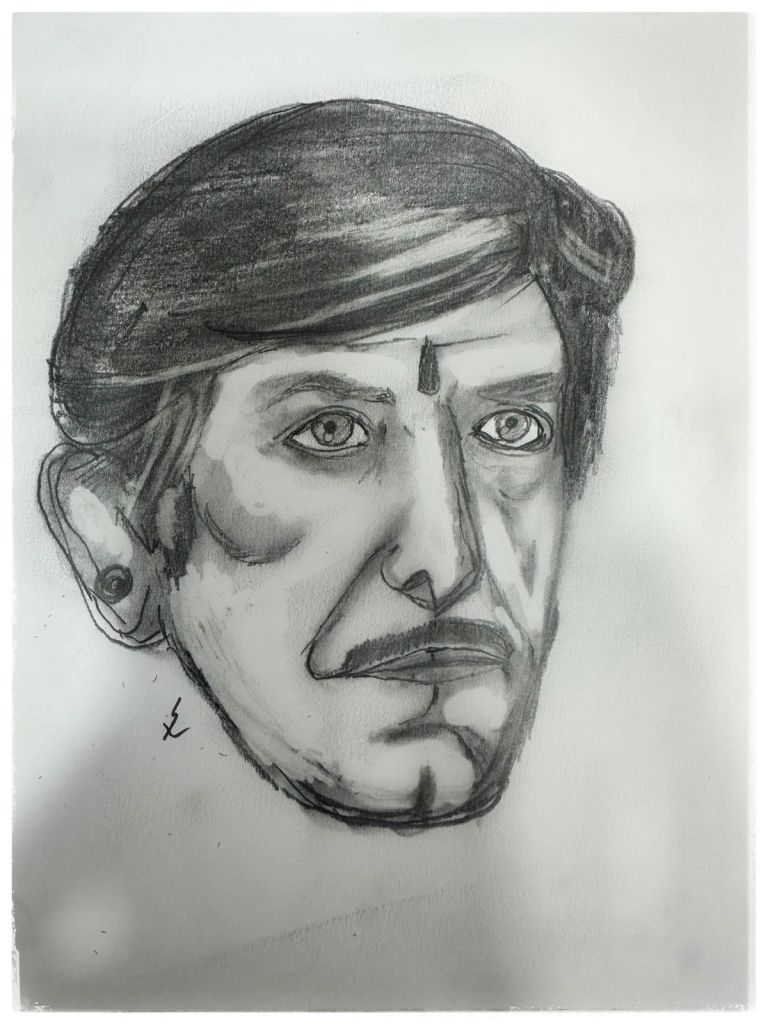
So Gallard who was a truthful guy decided to name the fruit the “Granny Smith,” in honour of the little old lady who first cultivated it! This is so opposite to the usual credit hungry Homo Sapien! We must also appreciate Gallard for this! So anyway they were marketed and pretty soon became pretty famous and continue to do so even now! Some legacies live on long after people are gone just like the legacy of Manna Dey! One of my best sketches of him which probably reflects my respect for his skill!

Now have some sweet or sour apple and sleep!

Shubh Ratri!

Jack of all trades! King of a ton!

“She takes the charge from day one!

Her sacrifices and her work stands tall

She is the mother the Jack of all trades! 

And also the queen of them all!”

In a famous song, The big B Says how when you curse us it feels like blessing while when we bless you, it feels like curse! The essence there was rich and poor while it is understood that the curse or blessing is dependent on the relationship between the giver and taker! If they are good friends and cordial to each other then keeping other things aside, it is understood that among friends any wishes is blessing and among enemies, any interaction even if it is soft seems like curse!

In the same way some people can mistake a complement to be a curse or sarcasm because in this day and age, people take more pleasure in criticism than praise! The age of true praise is dwindling and anyone who praises is seen with doubtful eyes! 

In that same way one of the biggest praise of yesteryears is now seen as a curse or not a compliment especially if you are good are many things! 

Now If you are a person with a multitude of interests and passions and have the undying urge to explore new things and acquire more knowledge and different skills. If you want to do many things at a time and try to practice to excel in them then instead of praise you are sure to get a critical assesment!

You will be called “jack of all trades but master of none!”

It is a great defence for the narrow minded person to give a insult in form of a compliment! The fact that someone tries to do many things must actually be an inspiration for everyone to get out there and do more stuff! If you stop and start comparing then you will never get anywhere! Once you realise that there always be someone who can do better than you, then you must try to do stuff different or with more variety that him or her! So if you sketch well but someone can do better then write a blog and if someone is a better blogger than you then write a poem and you get the drift!! 

Then the only competition you would have would be with yourself! 

Now coming to this popular saying, it was initially meant to be a compliment!

Let us see how! 

So the phrase dates back to the 14th century. At this time, the name Jack was typically used to describe an ordinary man. An example of this can be found in John Gower’s Middle English poem Confessio Amantis (1390).

“They seie, ‘A good felawe is Jacke’.”

It is said that these people were working-class and often had to supplement their meagre income by doing other jobs. For example, a builder would supplement his income by painting or farming. Thus, they were not particularly good at the extra jobs that they took on but they were good in one job and doing extra ones as a complimentary work!

So it could have meant that Jack was good in one work and not an expert in other work but still manageable!

The first places where the phrase was recorded was in Robert Greene’s 1592 booklet Greene’s Groats-Worth of Wit, where he refers to William Shakespeare as a “jack of all trades”! 

This was because he worked on sets of plays and learned all of the jobs and roles that he could and would fill in wherever he was needed! And he used the area as his learning ground and became one of the most well-known playwrights in history! So he was expert in all! A compliment!

In fact Jack and Cracker if mixed together actually means an expert!

So someone who’s a crackerjack is really good at what they do. Like a crackerjack of a magician will amaze you with every trick he or she performs.

In fact the word can be used for any excellent thing or person — you might say, for example, that your new car is a crackerjack or compliment your friend on her crackerjack of a performance at the school talent show! 

Now no one knows how the compliment became an insult but still if someone calls you a Jack of all trades then it is up to YOU to take it as a compliment or an insult because the person who says it may not realise the effort and dedication it takes to learn or do multiple things consistently and properly! The jack of all Trades as a compliment reminds me of this family of M S swaminathan who was responsible for the green revolution and his daughter and Birthday celebrity Soumya Swaminathan!

Now show your expertise in sleep!

Shubh ratri!