Libyan Glass!


Everyone has class…I mean Glass!

It is really frustrating when a glass breaks! But (he he!) you have to understand that glass is essentially an artificially made solid from liquid!

Did you know there is a type of glass which is so rare because it is natural and made by an asteroid impact which generated hear to more than 1600 degrees!?

When it comes to glass, all you can do is be amazed! I have lost count of the number of glass articles I have broken! Clumsy and butter fingers are my nicknames!

Then again if it is not a mirror then it is not bad luck! At least that is what I say to comfort myself!

We all know glass is so delicate which is why we cannot get over this fact when it is made to be bullet proof or the floor of a tall building and you can see down in disbelief!

It is actually an amorphous solid—a state somewhere between those two states of matter.

Made from melting sand, soda ash, and limestone at a high enough temperature, glass is structurally a liquid; however, it behaves like a solid at an ambient temperature.

Know that though, in proper temperature glass is a liquid!

Then you have the most rare and precious glass! The Libyan desert glass!

Since it is rare it has now become a legend!

Libyan desert glass is the name given to fragments of canary-yellow glass found scattered over hundreds of kilometres, between giant shifting sand dunes.

Interest in Libyan desert glass goes back more than 3,000 years. Among items recovered from King Tut’s burial chamber is a gold and jewel-encrusted breastplate. In the centre sits a beautiful scarab beetle, carved from Libyan desert glass!

Now how the glass formed has long puzzled scientists.

Studies show the Libyan desert glass formed about 29 million years ago. The glass is nearly pure silica, which requires temperatures above 1,600°C to form, and that is hotter than any igneous rock on Earth!

Apparently 28,500,000 years ago to be precise, the skies above North Africa were lit up by an asteroid hurtling through the atmosphere. The intense and immediate heat of this event fused the sands of the desert into a yellow-green tektite known as Libyan desert glass. Due to the lack of any visible impact crater, the most likely source is a low-density airburst explosion leading to the fusion of silica-rich sands roughly 28,500,000 years ago. Since then, Libyan desert glass has caught the eye of everyone from ancient Egyptian pharaohs to the scientists of today. the ancient Egyptians called these formations the Rock of God.

Now it is a cosmic event but when there is a cosmic event which had actually melted the Earth, then it is an event to be remembered! Also events to be remembered are the ones in which you have the singing sensation Falguni Pathak!

Now drink some water from any non Libyan glass and sleep!

Shubh ratri!

Habit!

This was a very interesting clue when we were young (er!)

If you take the first letter of this word then a bit remains, if you take two then bit remains and if you take three then it remains!

The answer of course was Habit! And just like the spelling, the meaning also stands testimonial to the fact that if you have a habit then it does remain!

So it is better to develop a good one!

But (putting a but in the middle of the blog is my habit!) did you know that the root of this word was related to clothes!?

The word habit is pulled from the Latin words habere, which means “have, consist of,” and habitus, which means “condition, or state of being.”

It also is derived from the French word habit (French pronunciation abi), which means clothes! In the 13th century, the word habit first just referred to clothing. The meaning then progressed to the more common use of the word, which is “acquired mode of behavior.”!

One of the best books specifically about habits and good habits is Atomic habits by James Clear.

In this he states how you must have demarcated zones for your habits! Basically which means that once a habit is ingrained then it is difficult to change! Like how you can’t eat in the bedroom and you must never sleep in the living room! When this becomes ingrained then unless you decide to sleep and go to the bedroom, you will not sleep!

One of the first things in the novel was on making the habits obvious! One of the first things to do is to make a scorecard on your current habits and classify them as good, bad or neutral!

Habit formation is the process by which a behavior, through regular repetition, becomes automatic or habitual. This is modeled as an increase in automaticity with the number of repetitions, up to an asymptote which is a plateau.

This process of habit formation can be slow but when it is established then it is difficult to change! Of course with some limits it has been found that the average time for anyone to reach the asymptote of automaticity or formation of habit was 66 days with a range of 18–254 days!

It has thus been suggested that if you want to change your bad habits to good one then you must adhere to some rules!

There are apparently four basic effect and response to any habit and if you want to change your habit then you must modify those!

The first is Craving which makes the habit attractive so try to make the habit unattractive! Second is when the habit is obvious so your cue is to make it hidden, the third is that bad habits are easy to learn or get so try to make it difficult! Finally bad habits are satisfying and rewarding so you can try to make them unsatisfying or unrewarding!

Now these are the simple answers on how to do it! It all depends on how you actually get it done! The intent and the persistence is the prime factor which makes a good habit stick. Of course man (or woman for that matter!) is a creature of habit and one chief habit of everyone is to give free advice which is so easy to give but difficult to follow!

But some habits like sketching or blogging can be good provided you have time and good intention! A legend with great intention which was fulfilled is Dr Viswanathan Shanta!

Do read about her!

Shubh ratri!

A hole (y) stomach!

Do you know that many information we have about the digestive system was due to a bullet and a near fatal accident!?

Then again a hole in the stomach made it all possible!

The experimentation and ethics are questionable of course!

So close to 200 years ago June 6, 1822 to be precise; St-Martin was accidentally shot with a musket at close range at the fur trading post on Mackinac Island. The charge of the musket shot left a hole through his side that healed to form a fistula aperture into his stomach

The bizarre window into his digestive system created the circumstances for a strangely intimate relationship between Martin, a Canadian fur trapper, and the fort doctor, William Beaumont! 

Beaumont was stationed at Fort Mackinac in the Michigan Territory and he treated Alexis St. Martin. Beaumont not only saved his life, but he allowed St. Martin to live with him as he recuperated. St. Martin’s convalescence lasted several years, affording Beaumont the opportunity to closely monitor the gradual recovery of his patient.   

Alexis St. Martin was a resilient young dude since the injury was so severe and he was never expected to recover! Forget live for so long!

Curiously, St. Martin’s wound healed as a fistula, with a permanent opening in his abdomen through which the interior of his stomach was visible from the outside of his body. Beaumont soon discovered that he was able to view the process of digestion via the nearly inch-wide hole leading to St. Martin’s stomach. Seizing upon this rare opportunity — and with St. Martin’s intermittent cooperation for the following ten years — Beaumont conducted hundreds of experiments on the functions of the human stomach. The results of these exhaustive investigations were published in Experiments and Observations on the Gastric Juice and the Physiology of Digestion in 1833.

There were over 250 different experiments in all, with most of them detailing how Beaumont placed various kinds of food directly into St. Martin’s stomach via the fistula. 

Most often, the food was kept in place by attaching it to a string that Beaumont left dangling outside of the hole to St. Martin’s stomach. Beaumont could then watch the processes of digestion by looking directly into the stomach.  

He would also remove the food at regularly timed intervals to take weight measurements, and then reinsert the food into the stomach again to continue his observations on digestion. As one might imagine, these experiments were often uncomfortable and painful for St. Martin.

But the poor bloke bore it all for food and accomodation and may be since someone took so much interest in him! 

Of course the experiments and process gave us deep insights to the process of digestion and do not worry, life was not totally unfair to Alexis St. Martin!

Later on Alexis St. Martin got married and that too happily! Anecdotal evidence of course! Since he later on had six children and the best part!?

Well, he outlived his doctor by several years! So a hole in the stomach can still be managed! A mental hole in the heart or your soul? Well, only God can save you!

Also note that not all doctors like to see patient simply as objects to experiment upon! Some are really great and in fact legendary! 

Like the 93 years old doctor Chilukuri Santhamma! Do read about her and get inspired while eating your dinner!

SHubh ratri!

Gobbledegook!

Do you know what is gobbledygook?

Or how about Onomatopoeia?

Before you call Mr Tharoor; lemme try to explain!

Now Onomatopoeia is a type of word, or the process of creating a word, that phonetically imitates, resembles, or suggests the sound that it describes.

Common onomatopoeias in English include animal noises such as Moo, meow, roar, and chirp! These are literally the voices made by the animal or bird and a Homo Sapien’s version of the same!

In the case of a frog croaking, there is actually a cultural and regional difference! So while the English sound is ribbit for species of frog found in North America; English verb croak is for the common frog!

See how foreign travel can even change the status of a frog!

Not only sounds but there are many words which are actually the spelling of how they sound or perceived to sound! Like hiccup, zoom, bang, beep and splash.

Even machines and their sounds are also often described with onomatopoeia: honk or beep-beep for the horn of an automobile, and vroom or brum for the internal combustion engine.

Even human is not spared! The sound of kiss is MWAH! I can literally hear my daughter saying, “that is so cringe dudda!”

So what is gobbledygook !?

Well, the gobbledygook is a language that is meaningless or is made unintelligible by excessive use of technical terms!

You might have heard of the simpler term for it called Gibberish!

So gibberish, also called jibber-jabber or gobbledygook, is speech that is (or appears to be) nonsense: ranging across speech sounds that are not actual words, pseudowords, language games and specialized jargon that seems nonsensical to outsiders!

The etymology of gibberish is uncertain. It is generally thought to be an onomatopoeia imitative of speech!

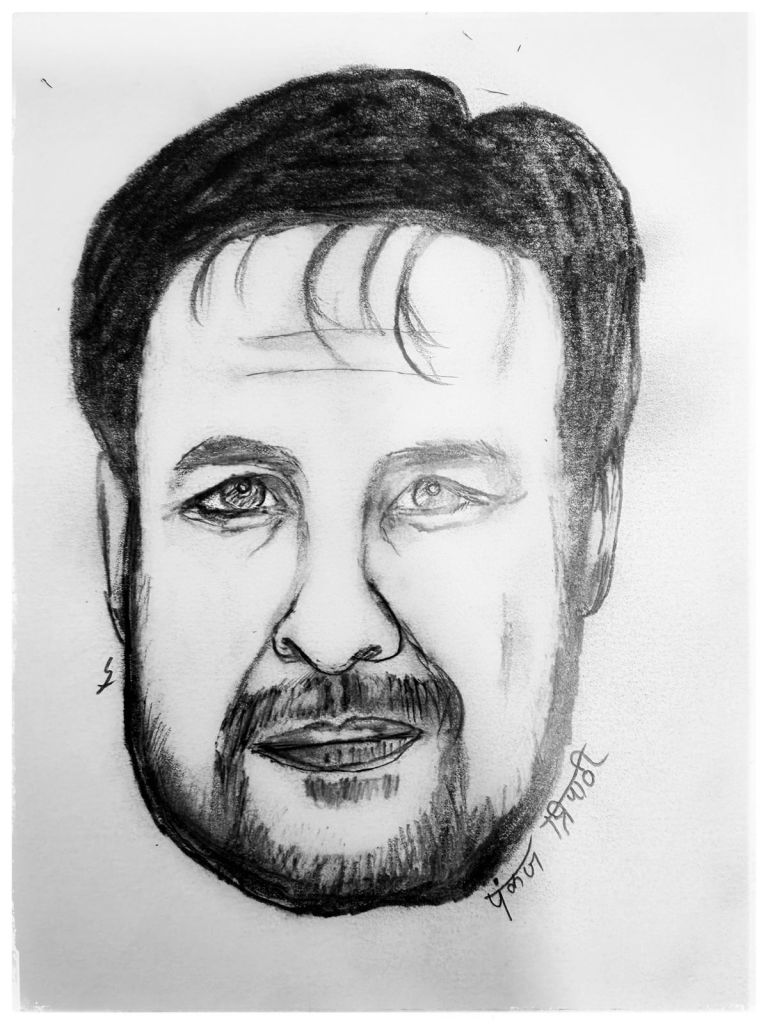
Yes! The irony is that even my blogs can sometimes be construed as gobbledygook! Hopefully not this one! Though it can be confusing like how when I say the sketch is of Sushant Singh and you think Rajput while it is another equally talented actor!

Now say whatever you say for good night in your Onomatopoeic way and sleep!

Shubh Ratri!

Happy official women’s day!

The rain was like a little bird which had just learnt to fly! It was going slow and steady and non stop! It would soar up a little and then wane down and then start again!

Bangalore roads or that small piece of land in between the mini puddles were trying to hold on to their identity and failing fast! The white or the black topping did not do much good other than the make up on a big scar which would reappear even more prominent with a quick wash!

I was wondering whether to take my bike and meet my mother to deliver her my special rice which she used to love to eat! I guess most good cooks like to taste food made by others! I may be an exception in the latter but then again maybe I am not that good! 

Now the bike would be fast but the car would be safe though frustratingly slow! The confusion which every Bangalorean faces every day and more so in the night when the traffic is sadly tragic! 

Two wheeler is always the best since you would at least move but if the rain is heavy then rest assured you would be like a wet cat! Irritable jumpy and cold! 

Also since I had food, it made more sense to take the car!

Praying fervently I rushed with the hot rice to my mom’s place to surprise her with my food! Of course I knew that she would have made her surprise ready for me and my kids! I gave her one box of my rice only to be handed two big ones and a gleaming mom!

It was the famous aloo bonda and her special Ribbon Pakodas freshly taken out of the hot oil! It was deepawali next week and she was getting ready!

She gave me a look at my surprise and when I was going to scold her for straining too much she just said, “It is ok! I took rest in between!”

Of course I was also happy to get the special treat! She had many who would give anything for a bite of her delicious snacks!

Then again that was the last time I could give her my rice and get snacks from her. The taste of those final treats still lingers in my memory…

Then the other day I was just thinking how it was almost four years since that fateful day and was rushing to reach home! I had prepared some notes for my daughter’s exams and it was late night special duty!

Luckily there was no traffic or confusion on which vehicle to take since I had only one and driving in this place is super fun! 

Reached home to see her reading with full concentration and handed the notes to which she handed her own! I looked at her with a fake anger (a father can never be actually angry at his daughter anyway!) mentioning how she must not strain so much before exam and take rest! She simply mentioned, “It is ok dudda! I took rest in between!”…

Luckiest are those who have loving mother, amazing wife, great supporting sister and a lovely and absolutely marvellous daughter!

To all the lovely ladies out there who do should be pampered the whole year as a rule! A very happy official Women’s day!

Signing off with a sketch of Hellen Keller…

Shubh Ratri…

God/Mom bless…

Our big brother!

When you have a big brother or an elder sister then you know that you will be a little safe! You will be protected or at least guided!

You would know what to do and more importantly what not to do!

The expectations would be lesser and the stress too!

Do you know that even the Mighty Earth has a big brother or sister who protects it and has been doing it for millions of years!?

This mega or giant planet is Jupiter which revolves the Sun once in twelve years which is maybe why the Maha Khumbh Mela is celebrated once in twelve years!

In Carl Sagan’s Cosmos it has been said that Jupiter is a failed star because it is made of the same elements (hydrogen and helium) as is the Sun, but it is not massive enough to have the internal pressure and temperature necessary to cause hydrogen to fuse to helium, the energy source that powers the sun and most other stars.

However, Jupiter has only about 0.1 percent the mass of the sun, and as it is definitely not a star, we can’t really call the solar system a double star.
If Jupiter had tried little more then we would be a two star system! And the day would be 24 hours! No nights at all! But then I love the night since it makes me appreciate the day more! And of course normal people sleep in the night! So what if Jupiter is not a star! It is a star planet!

And more importantly it is the big brother or sister protector of the Earth!

Some astronomers believe that one reason Earth is habitable is that the gravity of Jupiter does help protect us from some comets. Long-period comets, in particular, enter the solar system from its outer reaches.
Jupiter’s gravity is thought to sling most of these fast-moving ice balls out of the solar system before they can get close to Earth.
So long-period comets are thought to strike Earth only on very long timescales of millions or tens of millions of years.

Without Jupiter nearby, long-period comets would collide with our planet much more frequently. But Jupiter creates both good and bad conditions for earthly life just like any elder brother or sister gives you challenges in life to make you stronger!

Consider that its powerful gravity prevented space rocks orbiting near it from coalescing into a planet, and that’s why our solar system today has an asteroid belt, consisting of hundreds of thousands of small flying chunks of debris! If you are planning to go beyond the realms of the solar system then apart from the basic issues of space flight; you must cross this obstacle course to succeed!

You of course can succeed only by training and asking questions! Reminding me of the one who always has a question ready! Arnab Ranjan Goswami!

Now if the answer to the question, ‘Are you sleepy?’ in affirmative then please sleep!

Shubh ratri!

Makarand

The best (or the worst!) thing about morals and sayings is that almost every moral or saying will have an equally popular but opposite moral or saying! There are so many examples of that!

One person may say “All good things come to those who wait ” while another will say
“Time and tide wait for no man” These patterns are called Opposite proverbs!
Here are a few! Wise men think alike is more of less opposite to Fools seldom differ!
One of the most popular adage is, ‘The best things in life are free’ which is opposed by another famous proverb, ‘There’s no such thing as a free lunch!’
One of the most famous is, ‘Slow and steady wins the race’ which is antagonized by ‘Time waits for no man’!

The only thing which I have been able to decipher is that life is not just a single proverb or principle! It is a balance of the opposites! Unless you have a proper balance, it will not work! Like the Deva and Asura (or more accurately Sura and Asura)!

One of the constant advice given by elders and your teacher or boss is usually to finish your work in time and not to procrastinate!

Now everyone knows Procrastination is the act of unnecessarily and voluntarily delaying or postponing something despite knowing that there will be negative consequences for doing so. It is often perceived as a negative trait due to its hindering effect on one’s productivity, associated with depression, low self-esteem, guilt, and feelings of inadequacy.
But there is a catch here! It can also be considered a wise response to certain demands that could present risky or negative outcomes or require waiting for new information to come!

In fact there is a new term which is almost as bad as Procrastinate which is in fact almost the opposite meaning!
So this is the act of completing tasks as soon as possible even if it costs extra effort or the quality of the outcome deteriorates!
Some people may use this approach in order to avoid the anxiety and stress of last-minute work!
In some areas this faster but inefficient completion of work is actually considered an unhealthy behavior pattern and is accompanied by symptoms such as conscientiousness, eagerness to please, and high energy!

It has been observed that people who do this may try to find shortcuts to be more efficient and productive, but it may result in outcome which is inferior or
undesirable! The action is impulsive and close to reckless!

The term which describes such a feature is now known as Precrastination!
So if your boss or teacher or parent is telling you to hurry up or Precrastinate! Tell them that it is not advisable! Of course do not procrastinate also for too long! Go for the balance! I have recommending a new term for that balance! Crastinate!

Balanced or crastinated (not a real word but it fits! So I am thinking that if it used regularly then it will be accepted in the ever expanding English vocabulary!) performance also was of birthday celebrity Makarand Deshpande! You may not know him by name if you procrastinate and not search in Google but if you Precrastinate, you will instantly ‘crastinate’ and recognize him!

Now if you want crastination in your life then sleep on time! Neither pre nor pro!
Shubh Ratri!

Bijjaladeva

One of the biggest fears nowadays is the fear of death! Not of the human but of the mobile battery!

The greatest disappointment is also when you plug in the phone to get charged and the plug is not turned on!

You come back to see that the phone not only did not get charged but it has drained further!

The days of charging your phone once in a week or even a month is long gone! Now they feed on the charge at least once and sometimes more than that!

The future is not complete till you have a battery which can last long! ONe charge and it will stay juiced up for days or even months and a true miracle; even years!

I still remember how the poor remote of the TV used to start acting up when the battery was low! We used to kick and push and warm up the cell like giving CPR on the battery! Most of the times it used to work though!

Like the toothpaste which would be used till the last drop, the battery would be used till the last remaining electron!

Of course their history is also interesting!

Batteries have played an invaluable role in the history of physics, chemistry,
and industry.

Around 1780, physiologist Luigi Galvani experimented with frogs’ legs
that he could cause to jerk when in contact with metal. The spectacle of that
chorus line of flexing frog legs guaranteed Galvani sell-out crowds in
auditoriums the world over.

Galvani ascribed the leg movement to “animal electricity.”

However, Italian physicist and friend Alessandro Volta believed
that the phenomenon had more to do with the different metals Galvani
employed, which were joined by a moist connecting substance!

In 1800, Volta invented the first true battery, storing and releasing a charge through a chemical reaction instead of physically, which came to be known as the voltaic pile. The voltaic pile consisted of pairs of copper and zinc discs piled on top of each other, separated by a layer of cloth or cardboard soaked in brine (i.e., the electrolyte). He experimented with various metals and found that zinc and silver gave the best results

Of course these were ‘wet’ cells which were unpractical and cumbersome! Necessity lead to the development of the dry cell which was finally developed in 1886 by the German scientist Carl Gassner.

Now of course we have the leak proof batteries and cells but still sometime it does leak! Old remotes and other smaller devices which used to run on these older batteries used to show the leaks in forms of rust and disfigurement as a testament to the association!

Finally now you have the cool dry Lithium batteries which can be recharged and used for so long! The only issue is the drain! Then again an average phone now has drainage dependent stuff going on constantly! Be it the wireless or the location or the bluetooth or even the cellular service! Not to mention the apps running in the background! No wonder the poor phone is always power starved!

Power starved also was the character Bijjaladeva played by Nassar! But still pretty solid!

Now put your phone to charge and sleep!

Shubh ratri!

Not the tallest! So what!?

As you grow older you realise that one plus one is not two!

Our textbooks are full of facts which can be questioned! They are full of great people with questionable characters and finally there are actually just an iota of actual truth or fact between a veritable mountain of exaggeration!

Talking about Mountains; everyone knows about the tallest one in the world! Mount Everest stands tall! But if you measure the height from the floor to the top then there are two contenders!

Mount  Everest, the tallest mountain on Earth (at least on land!) stands just 5.5 miles high! But the actual tallest mountain when measured from base to peak, is Hawaii’s Mauna Kea, which originates at the bottom of the ocean, is far taller than Everest, at about 33,500 feet (10,210 meters).

Of course measured from sea level, Mauna Kea reaches only about 13,800 feet (4,200 meters)!

Just when Mauna was rejoicing, comes the actual tallest mountain in the Solar System!

The highest mountain and volcano in the Solar System is on the planet Mars.!

It is called Olympus Mons and is 16 miles (24 kilometers) high which makes it about three times higher than Mt. Everest! Imagine that!

In addition to being very tall, it is also very wide (340 miles or 550 kilometers) and covers an area larger than the entire chain of Hawaiian islands. Olympus Mons is a very flat mountain which slopes by only 2 to 5 degrees. It is a shield volcano built up by eruptions of lava.

As described in this Novel by Ellis Silver, apparently Mars once had several active volcanoes, but they’re all extinct now!

The crust and mantle have become too thick for molten rock to break through from the core.  And this causes them to swell up and reach such heights!

So when even Everest is not the tallest then what’s the fate of the other smaller mountains!

Well, forget Everest (even the name was not its original!); in fact in Nepal it is known as Sagarmatha! Now whatever you call it or whatever be its height or whether it is the tallest in the world or in the universe; it makes no difference to the mountain!

It just stands tall touching the skies or at least reaching for it! Just how Jamshedji Nusserwanji Tata did and how!

Now of course it is the time to Sutnu! Which is sleep in Nepali!

Shubh Ratri!

Avante garde protection

It has often been said that the most precious things are protected by the strongest stuff or Armour!


Like the Pearl or even the brain!

Even within the skull, the toughest bone in the human body is given the job of protecting this organ system which can show how important it is!

Of course there is a bias here but then you cannot ignore the fact that the cochlea is located in the inner ear and it is so important that the toughest bone in the human body (the petrosal bone)!

The cochlea is a Greek name that means snail. Which is very fitting, considering the cochlea looks just like a snail shell!
And the turn of the Cochlea has to be exact! It is generally 2 3/4! That is the exact shape and turn of over 99 percent of the Homo Sapien which makes him or her listen to you!

Of course only the shape is just a small component of the complex physiology of hearing!

Approximately 24,000 hair fibers can be found within the cochlea. These hair cells are necessary for hearing.

If you still do not feel that hearing is important then just know that the cochlea is the first organ to develop completely and is formed 4 ½ months into a pregnancy so you can ideally start listening as early as 4 month in utero!

So when Arjuna tells about Chakravyuh and Abhimanyu ‘hears’ then you can accept it!

Even otherwise the ear is so important since you are supposed to ‘listen’ more! Not simply hear!

Also remember that just because you have said something does not mean that the other person has heard or even listened!

Another reason why this organ is so safely tucked inside is that what you hear is precious and what you comprehend is priceless! Which is why we have two ears!

All this on the world hearing day! Now listen to something pleasant like  Maa by Shankar Mahadevan and sleep!

Shubh Ratri!