May day!

Did you enjoy the labour day the other day!?

Lucky you!

Then again you have to thank stonemasons and a riot for your holiday!

So apparently on 21 April 1856, Australian stonemasons in Victoria undertook a mass stoppage as part of the eight-hour workday movement.

This started to become a yearly commemoration, inspiring American workers to have their first stoppage.

Then again the whole thing started to commemorate the 1886 Haymarket affair in Chicago. That was another strike which became chaos!

In that year beginning on 1 May, there was a general strike for the eight-hour workday. On 4 May, the police acted to disperse a public assembly in support of the strike when an unidentified person threw a bomb. The police responded by firing on the workers. The event led to the deaths of seven police officers and at least four civilians; sixty police officers were injured, as were one hundred and fifteen civilians.
Hundreds of labour leaders and sympathizers were later rounded-up and four were executed by hanging, after a trial that was seen as a miscarriage of justice! The jury and the judges were blamed to be very unfair and biased!

The following day on 5 May, in Milwaukee, Wisconsin, the state militia fired on a crowd of strikers killing seven, including a schoolboy and a man feeding chickens in his yard

In 1889 an international federation of socialist groups and trade unions designated May 1 as a day in support of workers, in commemoration of this Haymarket Riot in Chicago .

Five years later, U.S. Pres. Grover Cleveland, uneasy with the socialist origins of Workers’ Day, signed legislation to make Labor Day—already held in some states on the first Monday of September—the official U.S. holiday in honour of workers. Canada followed suit not long afterwards.

The Haymarket tragedy inspired generations of labour leaders, leftist activists, and artists and has been commemorated in monuments, murals, and posters throughout the world, especially in Europe and Latin America.

In 1893 the Haymarket Martyrs Monument was erected in a cemetery in the Chicago suburb of Forest Park. A statue dedicated to the slain police officers, erected in Haymarket Square in 1889, was moved to the Chicago Police Department’s training academy in the early 1970s after it was repeatedly damaged by leftist radicals.

Now that is history! Which leads to May day or Labour day! Some lucky ones get a holiday while many like us fake a smile and move on!

May day is thus a celebration of the work done by workers all over the world and a reiteration of the 8 hour a day work and six days in a week work rule!

Of course not everyone and every country has to follow the day! Though they do follow the 8 hour work rule most of the time!
A rule breaker of sorts also was Aruna with her unique roles!

Now you may not have had a holiday on may day, you can make tomorrow the star wars day!
Since then you can say MAY The fourth be with you!

Shubh Ratri!

latrine fall


Have you heard of a ‘latrine fall’? Or more accurately Erfurt latrine fall?

Yes, it is both what you are thinking and not what you are thinking!

Of all the ways to go, this is certainly not Noble!

Also remember that a petty fight can lead to a fall into the latrine!

Do read the blog only after taking some antacids!

So In July 1184, King Henry VI of the Hohenstaufen dynasty, who was ruler of Erfurt and the future Holy Roman Emperor, convoked a ‘Hoftag’, or informal assembly.

This was within the Petersberg citadel at Erfurt (in modern-day Germany).

The gathering aimed to address a dispute between the Archbishop of Mainz, Conrad of Wittelsbach, and Ludwig III, Landgrave of Thuringia.

The precise origins of the two men’s fight may not be known but people can fight over anything though land dispute seems to be the prime suspect! Closely followed by politics! Guess the world has not changed much for so many years!

Determined to mediate and resolve the feud, Henry summoned dozens of aristocrats and high-ranking officials from across the empire to attend a meeting! A Noble deed indeed!

The Hoftag commenced on the morning of 26 July, with many delegates arriving the day before, but it was not long before disaster struck.

The ancient wooden floor of the church collapsed under the combined weight of the nobles, and they were sent plummeting to the floor below! It of course did not help that the Nobles were in the prime of health and well fed!

Below waiting for them was the building’s fetid cesspit. Medieval latrines, primitive and often perilously constructed, were a far cry from the luxuries of modern sanitation, often amounting to nothing more than large pits where sewage was gathered. Erfurt was about to give a stark lesson in the dangers of such basic facilities!

Revolting and tragic in equal measure, an estimated 60 to 100 nobles perished: either crushed by the falling woodwork, drowned in the horrific contents of the latrine, or asphyxiated by the unholy fumes emitted by the rotting sewage!

Yet in spite of the huge death toll, all the key players in the dispute miraculously survived. King Henry and Archbishop Conrad escaped death by clinging to iron window railings.

Henry’s survival that day ensured that his reign dramatically reshaped politics in Europe. This might have taken a different turn had he perished in Erfurt’s cesspit.

Now in spite of the stink, I am sure everyone would be wondering whether the original dispute resolved? Well, the shocking event with toxic smell rendered any attempt of peace void in every sense!

It appears the enmity between Ludwig III and Archbishop Conrad may have persisted, but no Noble ever tried to intervene again especially indoors!

Hygiene was never a priority in this period, but the Erfurt Latrine Disaster stands as one of medieval Europe’s most bizarre and stomach-turning incidents! Luckily since ancient times, Hygiene has been given major importance in Bharat!

More importantly, any such dispute would have most probably solved by a discussion under a tree where the only risk would be an occasional bird dropping! A much better alternative to the  Erfurt latrine fall!

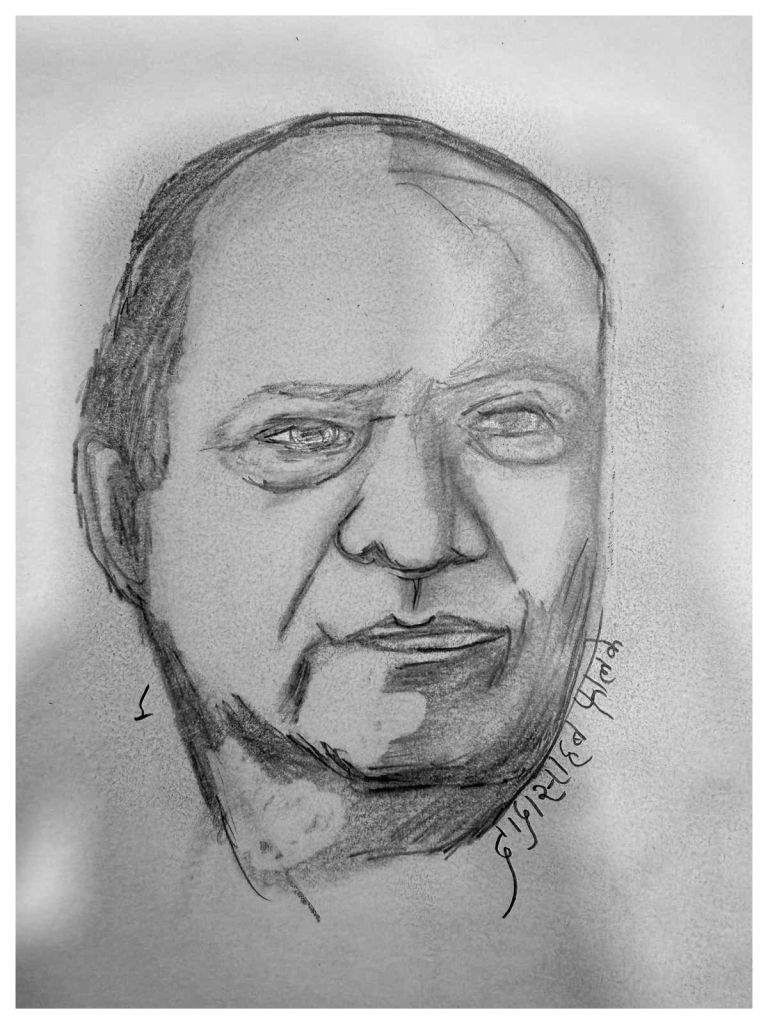
Now that was a tragedy but later on it did get a humorous angle. Humor reminds me of Mario Miranda! My natural talent is being a Cartoonist which is why if I do not concentrate fully, the sketch has a very high chance of looking cartoonish! Then again being a huge comic book nerd I love cartoons especially the ones by R K Laxman who is my top favorite! Love Mario Miranda’s sketches too since they are typical! A normal sketch with exaggerated nose eyes or other face features!

The sketch though is real! Not cartoonish! I hope!

Shubh ratri!

Dialetheism

Dialetheism is the view that there are statements which are both true and false. More precisely, it is the belief that there can be a true statement whose negation is also true. Such statements are called “true contradictions”, dialetheia, or non dualism

A dialetheia is a sentence, such that both it and its negation, are true. If falsity is assumed to be the truth of negation, a dialetheia is a sentence which is both true and false. Such a sentence is, or has, what is called a truth-value glut, in distinction to a gap, a sentence that is neither true nor false.

Dialetheism is the view that there are dialetheias’. If we define a contradiction as a couple of sentences of which one is the negation of the other, or as a conjunction of such sentences, then dialetheism amounts to the claim that there are true contradictions. As such, dialetheism opposes—contradicts—the Law of Non-Contradiction (LNC), sometimes also called the Law of Contradiction.

Aristotle was the one who introduced (what was later to be called) the LNC as “the most certain of all principles” in the book—firmissimum omnium principiorum, as the Medieval theologians said.

Dialetheism  was the viewpoint as mentioned in the book ‘In Contradiction’ by Graham Priest, who is credited with giving the first substantial argument for glut theory, and for its defense. (Priest, along with Richard Sylvan, née Routley, coined the neologism ‘dialetheism’, though there is no similar neologism coined for gap theory.)

Ambiguous situations may cause humans to affirm both a proposition and its negation. For example, if John stands in the doorway to a room, it may seem reasonable both to affirm that John is in the room and to affirm that John is not in the room!


The Jain philosophical doctrine of anekantavada—non-one-sidedness—states that all statements are true in some sense and false in another!
Simply put what looks like six to you may be nine to someone else!

In the end it’s a point of view!

Being right is only a time dependant factor! So if you are in an argument remember Dialetheism!

Of course there is no argument that people like Anand Gopal Mahindra are important for atma nirbhar bharat!

It is night but Dialetheism means that it is day somewhere else!

You make your choice! I have made a choice to sleep!

SHubh Ratri!

Crispy CRISPR

Do you know what is a CRISPR? No! It is not the Romanian word for the British word for, well chips!

By the way, In British English, ‘crisps’ refers to what North Americans call potato chips—thin, fried slices of potato, while ‘chips’ in the UK means French fries!

But CRISPR is not what you can eat but it is a scientific treat!

In a book called eugenics we see how the CRISPR-cas9 technique is making human gene editing seem more socially acceptable. This is a way to tackle the telomerase issue which is directly linked to ageing!

Jennifer Doudna and Emmanuelle Charpentier have been awarded the ultimate science prize for their breakthrough research on CRISPR technology! Their work and as well as the vital contributions of other scientists has paved the way for the emergence of CRISPR as the most powerful gene-editing tool!

The full form is a handful though! Clustered regularly interspaced palindromic repeats or (CRISPR)/Cas9! As mentioned before it is a gene-editing technology causing a major upheaval in biomedical research. It makes it possible to correct errors in the genome and turn on or off genes in cells and organisms quickly, cheaply and with relative ease.

Apparently the CRISPR/Cas9 system evolved naturally in bacteria and archaea as a defense mechanism against phage infection and plasmid transfer.

Now things get a little technical!

So Bacteria or archaea acquire a segment of their DNA sequence to insert into the CRISPR spacer region when first infiltrated by an exogenous phage or plasmid. If reinfected with homologous DNA, the bacterium will initiate transcription of the CRISPR region.

After a series of processing and maturation processes to generate a single guide RNA (sgRNA), the sgRNA guides Cas9 to shear the DNA strand that disrupts the homologous spacer region.
The recognition process of the sgRNA requires the involvement of protospacer-adjacent motifs (PAMs), a short guanine-enriched sequence.9

The preferred PAM by Streptococcus pyogenes Cas9 (SpCas9) is NGG, which is common in the genomes of most organisms, thereby facilitating the use of CRISPR technology across the fields of plant and animal science, together with biomedicine. This is where the CRISPR technology comes in!

By changing the nucleotide sequence of a small segment of guide RNA, CRISPR/Cas9 allows the accurate targeting of almost any desired genomic locus for the purpose of correcting disease-causing mutations or silencing genes associated with disease onset!

WIth proper research and more time the promising applications for this technology include the treatment of cancers, cardiovascular diseases, sickle cell anemia, and neurodegenerative disease!

In the future when there is a troubled Genetic disorder do not be alarmed if the doctor says, “Do not fret! We have the CRISPR!”
Then again do not pretend to know what it is anyway! Since it is not as easy as it seems! Then again it may not have been easy to make the first indian movie Raja Harishchandra truth be told! Which is why the biggest award in the cinema is named after him! Shri Dadasaheb Phalke!

Now do not eat any crisp of the potato kind in the night if you want to have a good sleep!

SHubh Ratri!

Bee the honey!

This may be the only food in the world which can never go bad!

It is also the word which your spouse can occasionally call you when she is ready to forgive you for her mistake!

No no! Stop imagining some animal!

It is Honey! The former one that is! the latter I am more or less sure!

Honey has been called the only food that truly lasts forever, thanks to its magical chemistry and the handiwork of bees. The nectar from flowers mixes with enzymes inside the bees that extract it, which changes the nectar’s composition and breaks it down into simple sugars that are deposited into honeycombs. Fanning action from the bees’ wings and the enzymes from their stomachs create a liquid that is both highly acidic and low in moisture!

Which is why it is so lucky that the Bees did not take after their ancestors!

Evolution wise bees and the wasps were actually cousins! Both Bees and Wasps have evolved from single ancestor; the Hunting wasps!

Bees evolved from hunting wasps more than 100 million years ago and it can be hard to tell the two apart!

One way to do this could be to take them out for dinner, as in general bees are vegetarian and wasps are carnivorous!

Only honey bees make large quantities of honey and wax. Bumblebees make a small amount of both, but not on the same commercial level. There are eleven species of honeybees, also known as ‘Apis’, worldwide but ‘Apis mellifera’ is the most productive honey producing species.

All bees forage for protein-rich pollen and sugar-rich nectar from flowers. Honeybees convert nectar into honey so that it can used as a source of food through the winter, when nectar is scarce. The honey has a higher calorific value than pure nectar and can be stored for longer as it is more resistant to bacterial degradation. A healthy colony can produce two or three times the amount of honey it needs.

Now the issue is that the wings of the Bees are actually smaller for their bodies and feels like a misfit! But nature is the perfect engineer!

Scientists used to think that a bee’s wings were rigid, making bees kind of like little planes that moved hard wings up and down. But bee wings are fairly small for their body size, so even at 230 beats per second, rigid wings wouldn’t be able to let bees fly!

Using high-quality video that could show the bee wing beats in slow motion, they finally figured the secret. Their wings are not rigid, but twist and rotate during flight. Bee wings make short, quick sweeping motions front and back, front and back.

This motion creates enough lift to make it possible for bees to fly. Scientists think that this inefficient style of flying bees lets them carry heavy loads when needed. That ability comes in handy a lot for honey bees, who carry nectar and pollen from flowers back to the hive! Bees of course are the most important species of the world!


Social bees protect themselves and their colonies by stinging, but you are unlikely to be stung unless you disturb a nest or handle a female bee roughly.

Most bee stings are very mild, but can be extremely dangerous if you are allergic to bee venom.

Bee venom is most potent in summer when protein-rich pollen is freely available.

Male bees, like the male Red mason bee, ‘Osmia bicornis’, don’t have a sting!
There are also many species of stingless bees.

You may have heard the phrase ‘the bee’s knees’; the saying means an outstandingly good person or thing! Like “all this car needs is a little fine tuning to make it the bee’s knees” but did you know that bees don’t actually have knees?

Bees have a rigid exoskeleton, a hard covering that supports and protects their bodies, rather than internal bones. They don’t have kneecaps, but they do have leg joints between the femur and tibia.

Then again the work they do make them outstanding! It is estimated that around 70% of the crops we eat rely on the interplay of plant and bee and they are one of the most important species on the Earth!

Important also are those who give everything to art! Like Chris bale!

A quick sketch but do concentrate on the blog! Honey!

Shubh ratri…

The legend ENT prof

Sometimes you do things only to make a show! It is done only for satisfaction! Absolutely nothing is changed but the person who demands or requests these changes feels better!

An interesting story in the book 48 laws of power tell about how once Michelangelo was showing his latest statue to a patron who was in all fairness not artistically inclined!

From afar he saw the statue and told Michelangelo that the nose was a little big! Michelangelo had a little hammer with him and his hands were dusty with the marble dust since he was working. He told the patron to come up while he made the necessary corrections.

He took the hammer and corrected the nose! Now the patron was happy with the final outcome!

So what you may ask!?

well! As the patron came close Michelangelo in fact he did nothing! He simply made an act of ‘modification’ and that’s that!

The patron simply saw the dust on Michelangelo’s hands and thought that some work was done!

All when Michelangelo did actually do nothing other than pamper the ego of a critic who had no inkling of art! Sometimes the best way to do stuff is to pretend to do it!

Once while working in a company as a medical writer, our senior whose knowledge of ‘medicine’ and ‘English’ was questionable asked me to rewrite the document with ‘his’ modifications; I simply made an act of rearranging the sentences! In fact I had changed only the first and last line of the whole document! I also remarked how ‘his’ ‘observation’ was spot on! This was because he was less qualified than me and he of course needed an ego boost! Though I did not know the law of power at that time, I at least knew the laws of corporate life! He was happy and I was spared for another day!

This is actually a very common occurrence all over the market! When you send the food to make the taste a little better or when you tell the dress to be altered just a little bit! Or when you tell the barber to trim a little bit more! By and large, the ‘modifications’ done would be so minute or in many cases none! The whole show is only to pamper your senior and his or her fragile ego!

Then once in a while you have seniors who make you be yourself! They like your honest opinion; in fact they want to listen to your opinion! They do not need an ego boost! They may not even appreciate your praise thinking it is a butter attempt! They read a lot and are knowledgeable but still are eager to learn everyday!

One such legend was Dr N K Majumder; I used to eagerly wait for his replies in our Whatsapp group since it would be full of his wide experience but his humorous take on everything was the cherry on the cake! Once while mentioning about the Cochlear Implant program and stating that there is a need for more rehab teachers he mentioned how, “Wishes can be enormous but they should have wings to fly!”

Well read and articulate with a command over language which would even make Tharoor proud! All when he was only 90 years…young!

There would be no ENT who does not know him! He will be missed but his legacy will be forever!

Heartfelt condolences to Professor Nirmalaya Kumar Majumder!

Om Shanthi…

Chasmology

Do you know what is Chasmology?

Now before you think, “Oh no! another boring blog! Time for me to YAWN!” well, you are close!

The book 48 laws of power by Robert Greene talks about the power of yawning! It makes your opponent calm and less aggressive! A typical yawn lasts for around 6 seconds and your heart rate significantly increases during that time!

And yes! The study of yawning is called chasmology!

It’s no surprise that People yawn more when shown a pattern of boring colors than when shown a 30-minute rock video!

Yawning usually happens in fits of two or three with increasing intensity.
A fetus starts yawning in the uterus at 12 weeks after conception. A fetus yawns around 25 times per day, and the frequency of yawning tends to decrease with age! Now now, it may not be because a typical mother has a relatively quiet and boring life!

Luckily though Humans cannot claim Yawning to be ‘human’ since it isn’t unique to humans!
Almost all vertebrate animals, including mammals, birds, reptiles, amphibians, and even fish, experience yawning. So if a radioactive fish does bite you then your super power may be; well you can yawn underwater!

There are three main hypothesis on why we yawn!

To “wake up” your brain is the idea behind the ‘arousal hypothesis’ which  states that yawning activates your brain. This theory is tied to the fact that tiredness and boredom tend to trigger yawning the most.
So, your body uses yawning to keep yourself awake. Several of your facial muscles tense and stretch during a yawn, which may also help wake you up.

Another theory is to fool…er I mean cool, you brain! The brain-cooling hypothesis suggests that brain temperature decreases with yawning due to the intake of excess air and changes in facial blood flow! Studies in both animals and humans show that yawning occurs before, during and after instances of abnormal thermoregulation, like heat stress and hyperthermia (high body temperature).

Then to bring in the fact that you need to communicate since you and me are social animals! It may be an act of communication! The communication hypothesis is based on the contagiousness of yawning. Researchers who support this theory think that yawning functions as a communication or group synchronization function. They think it might serve to signal boredom or feelings of stress to others around you.

Yawning of course is contagious but interesting is that yawns are most contagious among your closest friends. Researchers have discovered that the closer you are to someone genetically or emotionally, the more likely it is that you’ll ‘catch’ their yawn!

So the next time you see your wife or husband ‘YAWN’ you better do it! It may be that he or she has read my blog and is testing you!

If that made you smile then that reminds me of the mischevious smile of zohra sehgal!

Now stop yawning and sleep!

Elegant worm!


Do you know this, yes ‘this’ is the reason because of which people have got at least 4 Nobel prize!

It was also named because it is very ‘Elegant!’

Now Before you run your imaginations wild let you pop your enthusiasm bubble (I hate it when someone does that though!) and inform you that ‘it’ is a worm!

Now, this is no ordinary worm!

It is so popular among Nobel Laureates that they even shout out its name in their Nobel acceptance speech! That is an accolade few ‘humans’ get!

The worm is called Caenorhabditis elegans, a 1 millimetre nematode that’s been extensively studied as a model organism!

One of the winners of this year’s Nobel Prize in Physiology or Medicine, molecular biologist Gary Ruvkun, lauded the species with its highest honour so far, recognizing it as “badass” (now it is not confirmed whether a ‘worm’ can have an ‘ass’ though!)

The one-millimeter nematode has helped scientists understand how healthy cells are instructed to kill themselves and how the process goes awry in AIDS, strokes and degenerative diseases. (That work was the subject of the 2002 Nobel Prize in Physiology or Medicine!)

Self-proclaimed “worm people” were recognized by the Nobel committee in 2006 for discovering gene silencing, which became the basis for an entirely new class of drugs. Two years later, the chemistry prize went to scientists who used nematodes to help invent cellular “lanterns” that allowed biologists to see the inner workings of a cell!


For each prize, a laureate made sure to thank the worm for its contributions, though perhaps the most famous nod came from Sydney Brenner, who won the first “worm Nobel.”

“Without doubt, the fourth winner of the Nobel Prize this year is Caenorhabditis elegans,” he said in his lecture in Stockholm!

Now since the worm is like a saint of sorts, it apparently ‘refused’ any monetary gain was the ‘official’ statement!

Dr. Brenner, often thought of as the father of C. elegans research, is the closest thing there is to a worm celebrity. He is credited with popularizing C. elegans in laboratories worldwide, after spending almost a decade hunting for the perfect research model!

C. elegans is named after the Latin word for “elegant” because of the way it moves in graceful, sinusoidal waves. One of the animal’s virtues is its simplicity, which allows scientists to test hypotheses about fundamental biological concepts in a model that is easy to understand.

The nematodes have just 959 cells — a remarkably manageable number, compared with our trillions of cells — each of which scientists have named and charted from fertilization to death.

The destiny of each cell is easy to map, since the worms become translucent under the light of a microscope and cycle through all developmental stages in about three days.

The nematode was the first animal to have its genome entirely deciphered — in 1998, years before scientists were able to do the same for flies and mice. The worm is also inexpensive, easy to store and entirely self-sufficient when it comes to reproduction; female C. elegans have functional sperm that allow them to inseminate themselves!

Now that is a scary level of women’s rights or not depending on which side you are!
So the next time you have the enthusiasm of getting Noble and getting a Nobel; think ‘elegantly’!

Then again one elegant actress with great  mother roles is Saranya Ponvannan!

Now worm yourself to sleep!

Shubh ratri!

The third chimp…

Jared Diamond in his book “The Third Chimpanzee” tells us about the this species which is very close to the chimpanzee!

The chimpanzee immune system is surprisingly similar to this species!
Like most viruses that cause diseases like AIDS and hepatitis can infect chimpanzees too. But chimps don’t get infected by the malaria parasite Plasmodium falciparum, which a mosquito can transmit through its bite into this species blood. A small DNA difference makes this species red blood cells vulnerable to this parasite, while chimp blood cells are resistant!

So which is that species which is so similar to chimpanzee but worse than them since unless there is a risk of life or death, even a typical chimp would not kill another unarmed chimp!

Yes! Jared Diamond’s third Chimp is the Human!

Jared mentions how similar taxonomically chimps and humans are, as their genes differ by just 1.6%! In fact the chimps and gorillas differ by 2.3%!

Thus the chimp’s closest relatives are not the other apes with which it is classed, but the human.

In fact, the chimpanzee-human difference is smaller than some within-species distances! Going by genetic differences, humans should be treated as a third species of chimpanzee Or possibly the chimpanzee’s scientific name should be Homo troglodytes instead of Pan troglodytes.

But you may wonder If human and chimp DNA is 98.8 percent the same, why are we so different?

It is because of the play of numbers you see! Each human cell contains roughly three billion base pairs, or bits of information.

So a difference of just 1.2 percent of that equals about 35 million differences! Then again that is the Gene level! A difference of 1.2 percent makes the human, well human! Of course it may take a Noble prize worthy investigation to find out how to make him or her more HUMANE!

So don’t be very upset if someone calls you a monkey or a chimp! It’s just our distant cousin! Of course with the way the ‘Third Chimp’ is behaving, the chimp may take offense if it is compared to a human!

Of course there are some humans who are so artistic and talented that you know they are special! Do read about the artist Teejan bai…

A quick sketch with a dab of colour for a change…

Shubh ratri…

Scavengers clean…

The scene of a vulture in front of a dying person waiting for him to die is so heartbreaking but even the Vulture waits for the person to die since it cannot eat anything else and it does not have any choice.

One of the most dirtiest jobs but the most important are done by scavengers.

Scavengers play an important role the food web. They keep an ecosystem free of the bodies of dead animals, or carrion. Scavengers break down this organic material and recycle it into the ecosystem as nutrients.

Vultures only eat the bodies of dead animals.

Vultures have many biological adaptations that make them well-suited to being scavengers. Most have excellent eyesight and a strong sense of smell. They use these keen senses to locate rotting carrion while they are soaring high over land. Unlike raptors, or birds that hunt, vultures have weak talons and beaks. Raptors use sharp talons and beaks to kill, while vultures do not need to overpower or secure their prey. Many vultures are also bald, meaning they have no feathers on their head. This prevents bits of carrion, which can carry toxic bacteria, from sticking to feathers and infecting the bird.

Some mammals are scavengers. Hyenas are often thought of as scavengers, but are also traditional carnivores. A lone hyena feeds mostly on dead animals. In fact it also can eat alive ones with one of the strongest bites; also known as the laughing hyena, the spotted hyena (Crocuta crocuta) has the strongest-recorded bite of all carnivorous mammals—4,500 Newtons or 1,011 pounds of force!

They can even eat decaying putrid flesh without any issues. This is because they have strong stomach acids that break down virtually any pathogen, and their immune systems are resistant to the toxins produced by bacteria!

Then again these so called ‘animals’ do not have the superior ‘brain’ of the ‘human’. Which is ironic since they eat only the dead and eat only to live! They do not kill for pleasure or with an agenda.

When you can mercilessly kill an innocent unarmed person with an agenda then frankly think who is the real ANIMAL?

In fact those ‘humans’ are worse than the putrid skin eating bacteria since at least they have some ‘real CULTURE!’

Feeling extremely sad to be part of this supposedly intelligent creature which kills it’s one without any rhyme or reason…

At least there are some great human beings though who were both human and humane.
Like Our Dr Rajkumar…

Prayers for my brethren at Pahalgam…