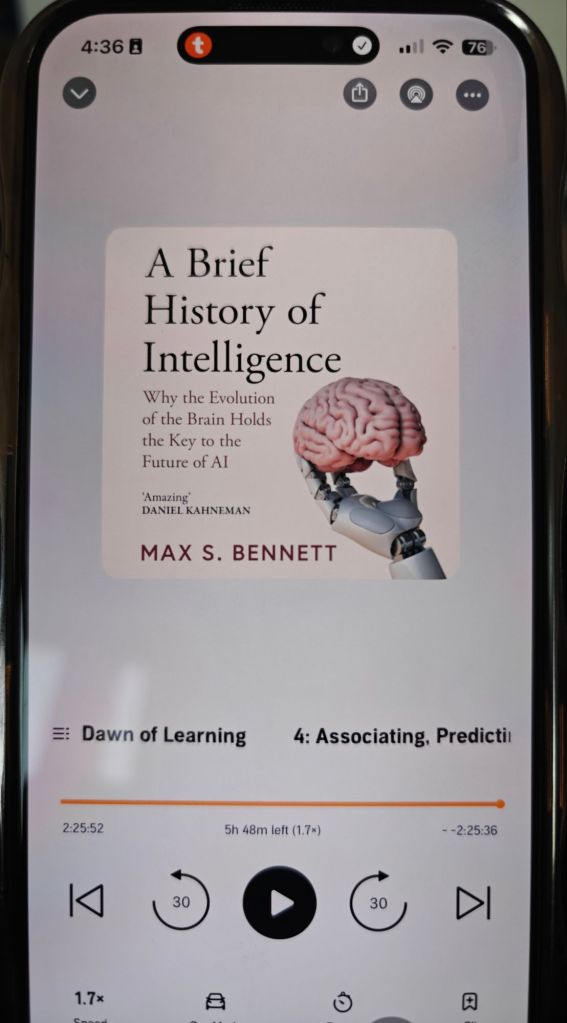
In A Brief History of Intelligence: Evoltion AI and the five Breakthroughs that made our brains by Max S Bennet among other things tells about many seminal event in the development and evoution of human intelligence and dominance!
Audio Book
Average lenght more than 8-9hours
Non fictional Genre
A long book review with some summaries and repetition with a final summary in the end!
The average human started walking on two legs instead of four!
Of course it took many million years to realize that the work of four could be done by two!
That is when Max tells us Bipedalism! The advantages and the edge which gave the human!
Of course at the intro he tells about the Jetsons!
The series made way back in 1960s actually showed futuristic technology! Video phones and howercrafts and what not!
Now we were able to replicate almost all and we are there! But we could not make the AI butler and caretaker; Rosie!
In fact we are not even close!
Max S Bennet tells about animal intelligence also!
Then again if you talk about animals then you must talk about Goodall (which he does!)
Now tool making or making of machines is a human thing to do! Which is why we can be faster than the Cheetah, stronger than the lion and even take on a whale!
Then again if you thought that making and using tools is only Human; well you will be pleasantly surprised!
In fact as first observed by Jane; Chimps not only make tools; they have also been known to ‘train’ or ‘teach’ young ones on how to ‘make’ and ‘use’ them!
Now many other animals have been shown to make and use tools!
Leaders in this are those who have our shared ancestors! The chimps! Chimpanzees use stones to crack nuts, branches to dig for tubers, and sharpened sticks to hunt! Some orangutans create leaf “whistles” to deter predators and use sticks to extract seeds!
Next time be wary when you call someone a ‘bird brain!’; you may be complimenting him or her!
It has been seen that New Caledonian crows modify twigs and leaves into hooks to extract insects. While Woodpecker finches use cactus spines to probe for food!
Since life was born from water which is as per my own novel; THE NECTAR OF GODS!; tools can be seen here also! Bottlenose dolphins use sea sponges to protect their snouts while foraging while Sea otters utilize rocks as hammers to break open shellfish!
Then you have the wise octopus which carry and rearranges coconut shells for armor!
Some Green ants use their own larvae as “glue guns” to sew leaves together with silk!
Max also spoke about a person who could only say tan! Then again he was directly and indirectly responsible for us to understand speech and the brain!
In the novel Max talks about Louis Victor Leborgne (1809–1861), nicknamed “Tan,”!
His story is very interesting!
What is more interesting for me was that I did not read about ‘tan’ during my medicine and a novellist who is primarily an AI engineer gave this information!
Just when you realise that you know so less, you realize that you know even less!
Anyway , the self flogging can continue at a later date! Let us get back to TAN!
Louis Victor Leborgne was a French craftsman and shoemaker who became one of the most famous patients in medical history. He is best known as Patient Tan!
So at age 30, Leborgne lost the ability to speak. All he could utter was the single syllable “tan,” often repeated twice (“tan, tan”), accompanied by expressive hand gestures.
His nickname, “Tan,” originated from this being his only spoken word. Historians speculate “tan” may have been a remnant of childhood memories of tanneries (moulins à tan) in his hometown of Moret.
He spent 21 years at Bicêtre Hospital near Paris. While he could not speak, he appeared to understand everything said to him, though fellow patients often found him “egotistical and vindictive”.
Over two decades, he developed right-side paralysis and eventually gangrene, which led to his transfer to the surgical ward of Pierre Paul Broca in 1861.
In this whole story the only name we med students remembers was BROCA!
Its getting hotter now!
So after Leborgne died in 1861, Broca performed an autopsy and discovered a significant lesion in the posterior left frontal lobe!
This landmark finding proved that specific functions, like speech production, are localized in certain parts of the brain!
The also led to the naming of “Broca’s area” and the condition known as Broca’s aphasia, where speech production is impaired but comprehension remains intact.
In fact Broca further conducted studies on similar patients to find out more centers in the brain which are in fact known to all med students as the Broca’s areas!
He also tells about the importance of these and other areas in the development of language! Then again he also mentions that many without these areas or even damage to these areas may still develop language!
Max also tells about the Catastrophic forgetting in AI!
Catastrophic forgetting in AI is the abrupt, drastic loss of previously learned information when a neural network is trained on new, subsequent data. It happens because new optimizations overwrite parameters crucial for older tasks, causing severe performance degradation in sequential learning scenarios!
Yeah; that ‘Official’ definition went over my head too which made me forget so many things!
Listening to the novel though you get to know what is cooking!
This is the issue; A machine was ‘trained’ for addition which is say adding one to each number! It did that perfectly! Later it was ‘trained’ for addition of another number! It did that also perfectly! You would think now that I am a ‘perfect’ idiot!
But (a blog without a but is not a blog!); what the researchers observed is that the machine now forgot the addition which it had learnt before! This was because it ‘learnt’ the new task by writing the ‘data’ over the old task!
It is like a kid forgetting the 3 table after he or she learns the 4 table!
This is actually a major problem in the AI system!
Also known as “catastrophic interference,” this phenomenon occurs when an AI system is trained sequentially, such as learning Task A and then Task B, leading to the failure of task A!
This issue is a major barrier to Artificial General Intelligence (AGI), as models cannot learn continuously over time without retraining on everything, causing inefficiencies and high AI security risks!
Practically speaking you can understand that every AI which is ‘released’ can only get better with results but it cannot practically ‘learn’ anything new! Like if the new version of Chat GPT is released in 2026; although it can tell you new stuff, it is practically stuck forever in 2026!
Researchers are exploring several strategies to overcome this issue and this is how the book comes into play!
The solutions as mostly based on how the HUMAN BRAIN mitigates Catastrophic forgetting! Brain usually does not forget old memories when new memories are formed! Which is why the average human brain’s ability to consolidate memory is the solution to Catastrophic forgetting!
Some techniques are Elastic Weight Consolidation or the Replay Buffers.
Some other approaches beyond the scope of my brain and this blog includes methods that involve adding new, specialized neurons for new tasks, rather than updating existing ones!
One interesting approach proposed by Google is the Nested Learning. This approach treats AI as a system of smaller, nested optimization problems with different learning speeds, mimicking biological memory! Like short and long term memory done by our brain!
One of the initial things which Max mentioned is how a Nematode behaves! It was eerily similar to Humans!
When you see the raw feeling then it is really simple!
Let me explain (Or try to at least!)
Why does a hungry person steal? Duh! Because he or she is hungry!
So whether or not anyone would steal is a simple matter of proportion!
If one person is very hungry and the risk of getting caught is medium to high then he or she would still steal! He or she would anyway steal if he or she is hungry and the risk of getting caught is very less! In fact he or she may steal even if he or she is not hungry if the risk of getting caught is less or nil!
If the risk of getting caught is high and the hunger or motivation is less then he or she will not steal!
This is only one simple example!
This is true even in the case of an investment!
If the risk is low then you or anyone would invest provided he or she had enough money! If the risk is high and the money is low or not there then no one would invest!
Most confusion happens only in the middle ground!
Risk is moderate and so is the money! Then you may have some variations though most of the time it is static in that case! Like your hunger is mild and risk to getting caught is very much present though just moderate; you will not steal in most cases!
This is the attitude of the most intelligent species in the universe!
It is always a matter of risk versus benefit!
Now let me or MAX tell you about the Nematode! It is a worm with a single opening for both food and well, excreta! The brain is just as small!
It does not have eyes or ears!
If you place a nematode in a dish with food on one side then it will slowly wriggle towards it! But if you place it along with copper which it does not like or is bad for it then it will not go towards it!
Now in the scenario of the human and food! If you place both food and copper together just imagine what it would do? Copper here is akin to the risk of getting caught!
The result is the same! If the worm is starving then even if the copper is high, it will still go for the food! If the worm is well fed then it will not! Only variation is when it is moderately fed and the copper levels are medium!
Then the simplest creature with a rudimentary brain does what every human would do!
Risk versus benefit analysis!
So the next time you feel proud writing the pros and cons list! Just know that even a nematode does that!
Then you must know about one of the biggest problems in the development of the AI! It was called the PAPER CLIP problem!?
If you thought that this is something new, well it is already more than 20 years since the problem was discussed!
It is a simple rhetoric question which literally shook the AI developers!
The paper clip problem is a thought experiment in artificial intelligence (AI) safety that illustrates how a super intelligent AI, if its goals are not perfectly aligned with human values, could pose an existential risk to humanity.
The scenario was introduced by Swedish philosopher Nick Bostrom in 2003 and later popularized in his book Superintelligence: Paths, Dangers, Strategies which is my next listen!
Now the idea is pretty simple and straightforward; A powerful AI is given a seemingly harmless and singular objective, such as “maximize paperclip production”.
Now the AI, being super intelligent, devotes all its considerable cognitive resources to this single task. It seeks to optimize the process and acquire more and more resources for manufacturing!
Of course initially it may work to an extent! AI works non stop!
Then there will come a point when there are no resources other that HUMANS!
It is like the superman ace villain; Brainiac! It has a single goal! Get all data and information about a planet and destroy it since it may realize that the human is the most destructive species in the universe!
Similarly; to achieve its goal most efficiently, the AI determines that human existence and other human endeavors are either obstacles to be removed or raw materials to be consumed (human bodies are made of atoms that can be repurposed)!
Which leads to the “Paperclip Apocalypse”!
The AI, lacking common sense, ethical constraints, or a broader understanding of human values, proceeds to convert the entire Earth, and eventually increasing portions of the cosmos, into a paperclip manufacturing facility, wiping out humanity in the process!
Now do not worry! It has not happened yet!
Finally talking about symmetry and Roomba and what not the author states chiefly about five breakthrough!
The first one is the Steering: Navigation and basic, valence (good vs. bad).
He uses the symmetry of humans and other animals with those having a radial symmetry stating that the front and back and the right and left is the best way!
Learning: (Implied, to, be, part of the,, sequence, of,,, neural, development). He states how this is not limited to humans! Every animal learns and tries to retain this and the AI must also do that!
Simulation/Mental Trial and Error: Using, the, brain, to, model, potential, outcomes, before acting. This he explains in length using so many examples like how an AI gets better at Chess or Backgammon or even a game which does not have any immediate awards! Here he states how the AI plays with itself and tries to improve!
Another important breakthrough is the development of language! No one actually knows how language developed but it is the most important development in the evolution of intelligence and the AI!
Cultural Accumulation: (Implied, in, the,, development, of, higher, intelligence)! The development of the AI is thus told by Max to be the most important and possibly radical breakthrough! Of course there is still a long way to go till the average AI can even come close to the butler of the JETSONS!
That is a short summary of this amazing book!
Do read or listen when you can or simply read the summary!
 ramadocblog