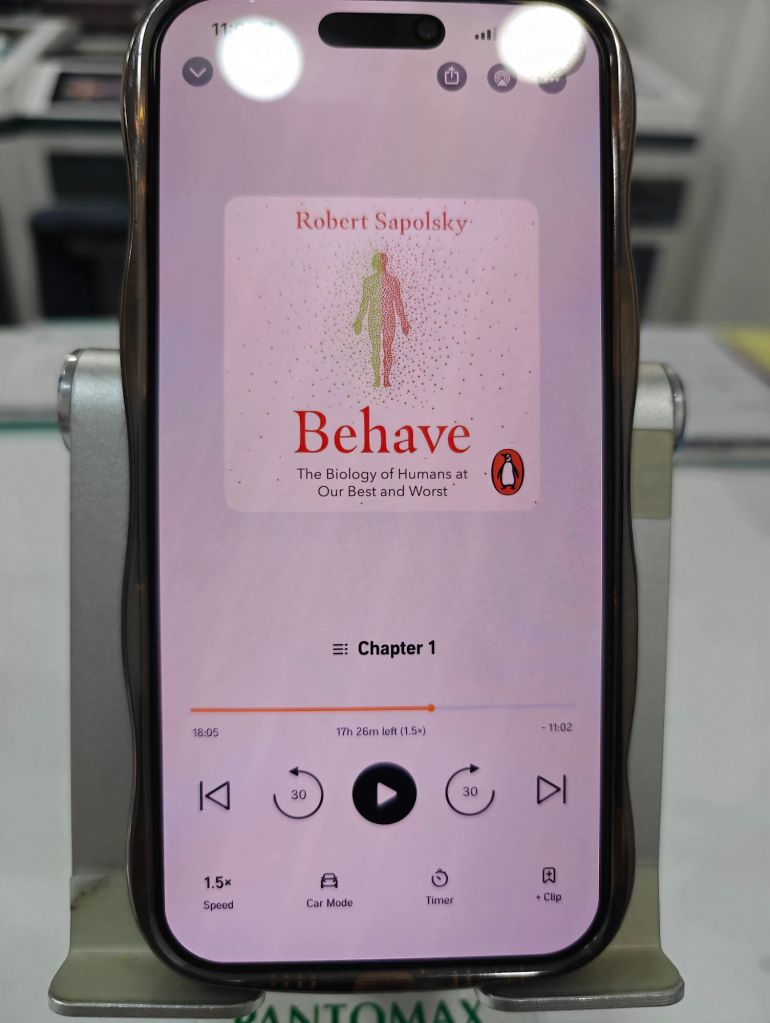
Behave: The Biology of Humans at Our Best and Worst by Robert Sapolsky
Audiobook of running length of more than 25 hours!
One of the longest books I have listened for a long time!
The author is a neurobiologist who primarily studied with Chimps!
The book is huge with so many aspects covered and the review being a short summary is also huge!
Since it is a non fiction, the review does not have any spoilers! It is a preview for those who may read or listen in the future (there goes your 25hours!) or a summary for those who may not have time to listen or read it (saved your 25 hours!)
Sapolsky’s central argument is that no single factor causes any given behavior; rather, every action is the result of an intricate combination of influences that occurred across vast time scales.
The book examines influences ranging from a milliseconds-old neurological event (brain chemistry and neural pathways) to factors hours and days earlier (hormones), and extending back to adolescence, childhood experiences, genetics, culture, and evolutionary pressures over millions of years.
Sapolsky delves into specific brain regions, such as the amygdala (associated with fear and aggression) and the frontal cortex (involved in reasoning and self-control), and how their interaction and development shape our choices.
The book explores the biological underpinnings of morality, empathy, and altruism, as well as the mechanisms that lead to tribalism and xenophobia (“us versus them” dynamics).
He takes it much further in terms of us vs them with examples galore!
In the book Behave by Robert Sapolsky he mentions about the specific centers in the brain which gets activated when you lie!
You would think that so what! It is just a lie! What you do not realize is that telling a lie is actually a very complex and sophisticated cognitive task!
It is simple to tell the truth since, well it is the truth! But to tell a lie involves planning and careful analysis!
You need to be very careful on what you say and then say it! Give only information which supports your lie and that is not a simple task!
Robert Sapolsky discusses the “train track question,” formally known as the trolley problem, in his book Behave to illustrate the complex interplay of neuroscience, emotion, and utilitarian reasoning in human morality!
The problem is usually asked in many variations!
The classic “trolley problem” presents two main scenarios:
The Switch Case: A runaway trolley is headed toward five people tied to the track. You are standing next to a lever. If you pull the lever, the trolley will divert onto a side track, where it will kill one person.
Most people (around 70%) say they would pull the lever, sacrificing one person to save five, which is a utilitarian decision (the ends justify the means).
The Footbridge Case (or “Fat Man” Case): The trolley is still headed for five people. This time, you are on a footbridge above the tracks, next to a large man.
The only way to stop the trolley is to push this man onto the tracks, killing him, but saving the five people. Far fewer people (around 25%) say they would do this!
Another variation is that the Fat Man is actually the person who is responsible for the tying the people on the track and is actually evil! Then almost 100 percent would tell that they would push him!
The distinction in people’s responses highlights a tension between immediate, emotional aversion to personally causing harm (pushing the man) and abstract, cognitive calculations of the greater good (pulling the lever).
Sapolsky notes that individuals with damage to the prefrontal cortex, a brain region critical for emotional regulation and decision-making, are more likely to make the purely utilitarian choice to push the man in the footbridge scenario!
Your choice would also be influenced if you know the person or persons involved! If you are too anxious you may not even make a choice and simply close your eyes to the whole problem!
Robert Sapolsky states how the recent amazing findings about Mirror Neurons are overhyped!
Mirror neurons are a specialized class of brain cells that fire both when an individual performs a specific action and when they observe another person performing that same action!
It is like the neuron responsible for Sympathy, empathy and compassion!
This dual firing apparently allows the brain to “mirror” others’ behaviors as if the observer were acting themselves!
In primates, they are primarily located in the ventral premotor cortex (area F5) and the inferior parietal lobule. In humans, activity consistent with mirror neurons has also been detected in the supplementary motor area and primary somatosensory cortex!
They have been theorized to provide a “felt understanding” of others, although many of these roles remain subjects of scientific debate!
The neurons apparently also facilitate learning by observation, especially in infants, by mentally rehearsing observed movements.
Of course the chief focus is that some researchers believe they are the neural basis for empathy, as the same brain regions for feeling an emotion (like disgust or pain) activate when seeing someone else experience it~
It was once widely proposed that mirror neuron dysfunction caused the social deficits in autism, but more recent evidence suggests this link is likely oversimplified or unsubstantiated and Robert is in that list who believes that they are just there!
Robert Sapolsky uses the example of a firing squad to illustrate the psychological concept of diffusion of responsibility and challenge our assumptions about free will and morality!
Now why a firing squad is used to execute is that if it is one to one shooting then the human may feel guilt (if some humanity is left that is!) even if the person who is to be shot ‘deserves’ it! So when you are a part of the squad then the morality is safe (r)!
Sapolsky states that humans have a deep-seated aversion to killing another person up close. So to counteract the psychological trauma and moral responsibility of an execution, historical firing squads employed specific practices:
One is like above; using multiple Shooters: Instead of one executioner, a team (typically five or more) fired simultaneously. This allowed each shooter to feel they were only one-fifth responsible, a comforting but irrational thought!
There is another key tactic also! Which is the Blank Cartridge!
A key historical tactic was giving one random member of the squad a blank cartridge instead of a live bullet. This provided every shooter with a psychological “out”—the ability to believe, with some plausible deniability, that “I may not even have shot him or her”!
No one is told who gets the blank and those with conscience get some comfort!
Even in the case of lethal injection; some states employ two injectors!
Both press the button and only one goes to the convict! One is diverted to a waste bucket!
The amount of energy and thought process to keep the humanity alive!
Robert Sapolsky also talks about Reciprocal altruism
Now it may sound complicated but it is fairly simple and you would have actually known and done the simple sounding version of this act!
Technically though reciprocal altruism is a social behavior where an organism helps another at a cost to itself, with the expectation of getting help in return later.
This is actually a crucial behavior in animals for cooperation among non-relatives, seen in baboons forming coalitions or cleaner fish cleaning larger fish, relying on memory and recognizing “cheaters” to maintain fairness!
Remember that the first act of altruism is not easy!
Acting altruistically (reducing own fitness) with the expectation of future reciprocation, boosting long-term fitness is the theme here and this term was coined by Robert Trivers in 1971 to explain cooperation beyond kin selection.
The fact here is that individuals help those who have helped them, often using past behavior as a cue for future reliability. The chief point here is that there is an essence of give and take! If you cheat in between you are out!
Organisms must remember past interactions to identify and avoid individuals who take help but don’t give it back (cheaters)!
If you thought it happens only in Humans; it is surprisingly common in animals!
Like say in Baboons, the Males form temporary alliances (coalitions) to gain mating access, expecting support later.
In fishes like the cleaner Fish, the small fish eat parasites off larger fish; larger fish protect them in return!
In many vampire Bats, the bats that fail to feed may receive regurgitated blood from a successful bat, expecting the favor returned.
In humans of course this is the norm! One individual helps another expecting the favor to be returned in kind or cash! Here the chief factor is trust! If you that is lost then the whole deal is out!
Robert actually uses the theme of prisoner’s dilemma to get the whole altruism details! It is a long loop of commit and defect!
Then you have the amygdala and the lies!
You have the phenotype and the proteins!
You have the nerve and the nerve junctions and the neurotransmitters! You have the types and how they can be increased or decreased!
You also have the end notes of DNA and proteins!
The final summary is that human behavior is a complex interplay of brain, environment, chemicals and genes! Like you did not know that already! Or did you!?
 ramadocblog