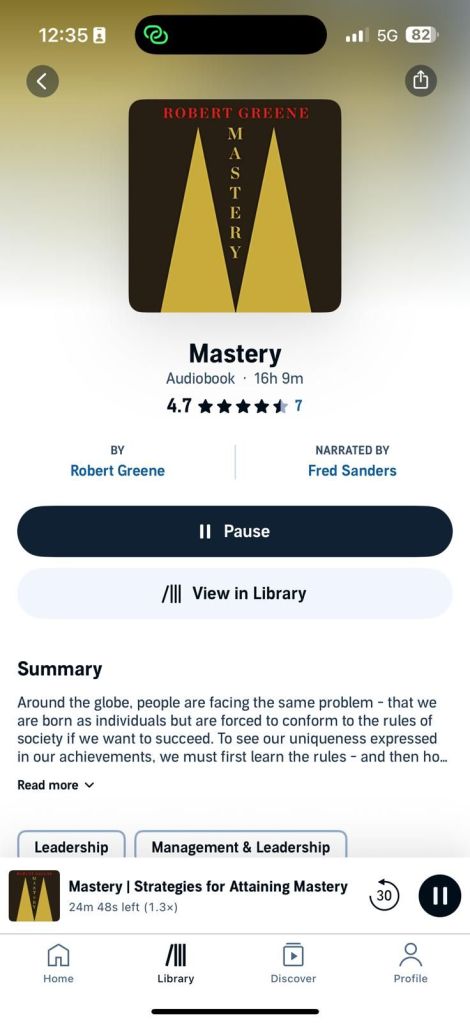
Mastery by Robert Greene
A non linear self help book
Audiobook with a running length of more than 15 hours!
One of the best books to read mainly because the narrative is full of stories of successful people! Then again many of the stories do not start with success but with struggle!
The review here is a long summary for those with less time and a preview for those those who may make time to read or listen to this one day!
How the weakness or the challenges are overcome and how they triumph!
In the case of some of them the success is actually realized much later in life which shows that life is not a race!
The summary of the book can be found in some specific points like
You must first discover your life’s task: Find your unique calling or vocation that aligns with your innate interests and passions to provide the necessary motivation and focus.
Finding a mentor is the most common theme but you must make sure that you get detached from the mentor when the time comes! Sometimes your experience itself will be your mentor! In the case of Faraday; he found his mentor but later on he realized that the mentor was limiting him and he had to break free and that was the best decision!
Another important trait is to gain social intelligence and understand human nature, people’s intentions, and how to work with others without being naïve. This is a critical skill to develop alongside your craft.
Study and absorb the details of your field until the knowledge and skills become effortless and intuitive. He also mentions how at least 7- 8 years is required for skill acquisition! In fact the brain rewiring takes around 10000 hours!
At which point the skill becomes natural! It becomes automatic or effortless after 20000 hours apparently!
So good things take time! Which is why we need to develop a long-term perspective: Understand that mastery is a result of time, intense focus, and a commitment to a lifetime of learning, not just talent!
Finally you must awaken your creative mind by moving past the apprenticeship phase to experiment, take risks, and synthesize knowledge from different areas to create new ideas and solve problems in innovative ways!
Most of these points are mentioned by narrating stories from the life and times of many successful and famous and some not so famous but still very successful people!
There is such an astute dissection on some important events of these people that this particular perspective is amazingly new and refreshing!
Charles Darwin and his life of chance! Studied barnacles for eight years before developing his theories, exemplifying the long apprenticeship needed for mastery. In fact he was a big failure and the chance to go in the ship was an after thought! On top of it all he was actually being prepared to join the clergy! Instead he came up with an theory which shook the world!
Leonardo da Vinci was a son with dubious father who had lots of time but no company! He also had access to paper and nature! He used them both and how! His early work, like painting an angel in a biblical scene, showed intense observation and detail, using scientific rigor in his art.
Wolfgang Amadeus Mozart: Used as an example of a natural prodigy who achieved mastery. But the real story is much more complex! He was a natural who was used by his father who was also his first mentor! Very soon he was the source of income for his whole family! So even though he was doing good by doing basic work he was not happy since his talent was not being utilized fully! One trip changed everything and he never looked back! He got separated from his father and their relationship was broken forever but his talent got wings and that created history!
Benjamin Franklin life from a normal leader to the president demonstrates the importance of social intelligence and the strategic use of networks to achieve mastery.
He talks about Paul Graham who is a contemporary example of a master in the tech world. He introduced radical changes in the way you invest in techs all over!
The story of the Wright Brothers was very enlightening starting from their work as cycle mechanics! Their dedication and experimental approach to flight are highlighted as a path to mastery! In fact their cycle shop was known for repairs and innovations! With a zeal for experimentation and research their crux was innovation which finally lead to the first flight and how!
Henry Ford: A key figure in industrial mastery and how his assembly line tech was used after careful observation and patience.
Temple Grandin was born with autism and had immense fear of human contact but needed them anyway! Then how she saw the cattle hug machine calming the cows made her try it and then rest as they say is history!
A contemporary example of a master in a field that uses a unique perspective. She developed a hugging machine for both cattle’s and for those special humans with autism and is now an expert in her field!
Other experts who were mentioned were done with special emphasis on how their struggles taught them! How mastery takes time! How you can be different and still be better! How innovation takes time!
The lists include John Coltrane a musical master, Martha Graham a modern dance master and our own V.S. Ramachandran whose work is used to illustrate pursuing opportunities within and related to one’s current field!
One of the most interesting story is about this boxer who becomes a coach at the middle part of his life after so many big failures!
The boxer Manny Pacquiao, who is used as an example of a master alongside his trainer, Freddie Roach. Mastery highlights their dynamic as a successful mentor-student relationship where Roach pushed Pacquiao to become a dominant boxer.
Greene discusses how Pacquiao was a promising but “middling one-punch fighter” until he began working with Freddie Roach.
Roach recognized Pacquiao’s potential and helped him develop his skills, with the two creating a powerful interactive relationship.
The partnership led to Pacquiao developing a devastating right hand and exceptional footwork, contributing to his successful career as an eight-division world champion!
The way the author uses these life stories to get his point across is simply energizing since they are all true! The stories take time to get to the point and it is slow! Which is how true success and mastery should be!
The end note is about the mention of the intermaxillary bone in the context of the scientist Goethe.
The book discusses how Goethe was determined to find the non-existent intermaxillary bone in humans, which at the time was believed to only exist in lower animals, to prove a connection between all life forms. Through extensive research, he discovered remnants of this bone (part of the larger maxillary bone structure) in the upper cheekbones of human infant!
Goethe is of course Johann Wolfgang von Goethe.
Greene describes Goethe as the epitome of the Renaissance ideal of the “Universal Man”—a person with deep knowledge across various fields like with the example above.
Greene mentions how to utilize your working environment. The author notes that Goethe spent a period in a petty court culture but, rather than engaging in the pettiness, used the observed behavior as material for his later plays and novels.
All in all; when you get live examples you do get energized! There is a level of reality which drives you forward! One book can do it for you or many but this is certainly one of those books which can inspire you!
 ramadocblog