This is a drop but named a Prince though shaped like a young frog!
Now it may not be the Frog prince so do not try to kiss it!
But it is one of the strongest substance known!
The full name of this is Prince Rupert’s Drop! They are also known as Dutch tears or Batavian tears!
It does look like a tear but more closely a young frog or Tadpole!
So the tadpole-shaped glass bead is created by dripping molten glass into cold water, which causes it to solidify rapidly. The drop exhibits a paradoxical combination of strength and fragility; the head is very strong, while the entire drop will shatter explosively if the tail is broken!
Yes! Prince Rupert’s drops have remained a scientific curiosity for nearly 400 years due to the two unusual mechanical properties: when the tail is snipped, the drop disintegrates explosively into powder, whereas the bulbous head can withstand compressive forces of up to 664.3 kilonewtons (149,300 lbf)!
One of the few examples where the head is literally headstrong!
The explosive disintegration arises due to multiple crack bifurcation events when the tail is cut – a single crack is accelerated in the tensile residual stress field in the center of the tail and bifurcates after it reaches a critical velocity of 1,450–1,900 metres per second (3,200–4,300 mph)!
Given these high speeds, the disintegration process due to crack bifurcation can only be inferred by looking into the tail and employing a high-speed camera. This is perhaps why this curious property of the drops remained unexplained for centuries!
The second unusual property of the drops, namely the strength of the heads, is a direct consequence of large compressive residual stresses—up to 700 megapascals (100,000 psi)—that exist in the vicinity of the head’s outer surface!
This stress distribution is measured by using glass’s natural property of stress-induced birefringence and by employing techniques of 3D photoelasticity. The high fracture toughness due to residual compressive stresses makes Prince Rupert’s drops one of the earliest examples of toughened glass!
Now if you are as curious or inquisitive as me then you would probably ask who is this Prince Rupert!? Now although Prince Rupert did not discover the drops, he was responsible for bringing them to Britain in 1660. He gave them to King Charles II, who in turn delivered them in 1661 to the Royal Society for scientific study! Now that is luck! Like how the amazing thing is finally named after the one who simply delivered the news! Like how Mt Everest got its name from the person who simply was in the right place at the right time!
There is also an Indian connection by the way (always love those!); In 1994, Srinivasan Chandrasekar, an engineering professor at Purdue University, and Munawar Chaudhri, head of the materials group at the University of Cambridge, used high-speed framing photography to observe the drop-shattering process and concluded that while the surface of the drops experiences highly compressive stresses, the inside experiences high tension forces, creating a state of unequal equilibrium which can easily be disturbed by breaking the tail!
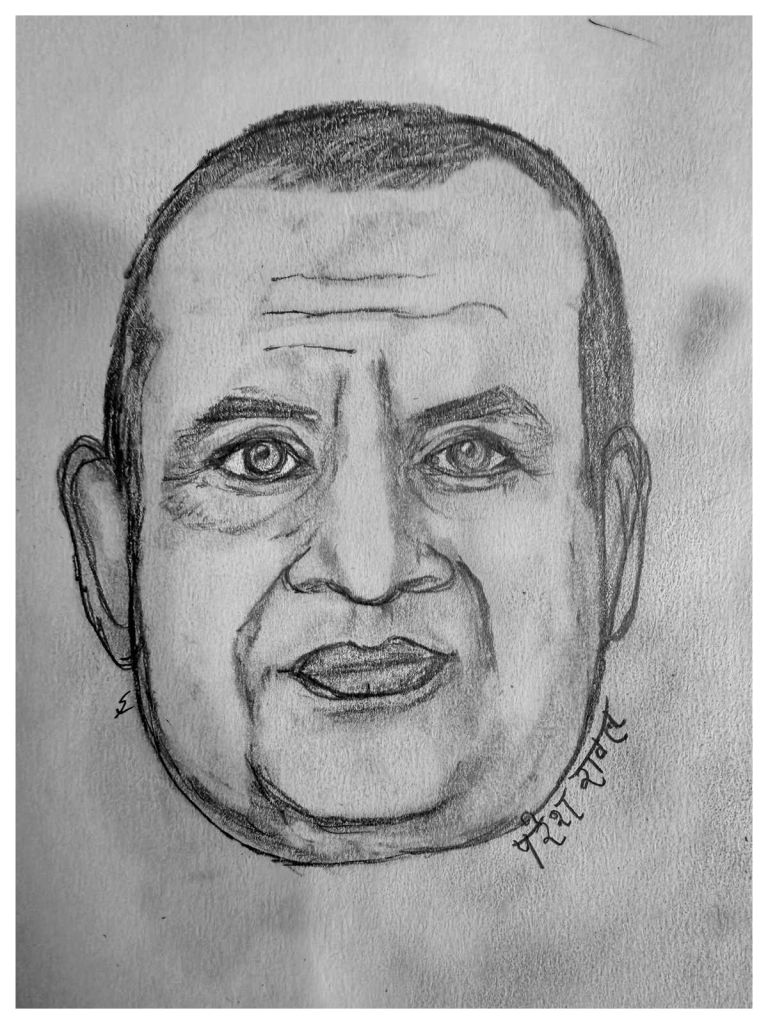
Prince of comedy also is Paresh Rawal! And a strong actor too like the glass drop!
Now remember that even the front of a high flying aircraft with unbelievable pressure and speed is actually glass!
Don’t lose your sleep over it!
Shubh ratri!
 ramadocblog