This was a remixed version which became popular and is still in use!
But it was not the original!
Edison and the light bulb!
The electric light, one of the everyday conveniences that most affects our lives, was not “invented” in the traditional sense in 1879 by Thomas Alva Edison, although he could be said to have created the first commercially practical incandescent light!
To credit one person as the sole ‘inventor’ of the light bulb would be a disservice to close to over 20 inventors of incandescent lamps prior to Edison’s version.
Then again, there is a difference between the first and the best!
Three things made Edison’s bulb the best at the time; an effective incandescent material, a higher vacuum and a high resistance that made power distribution from a centralized source economically viable.
But if you talk about earliest light bulb then that was close to 80 years before Edison which was in 1802 by Humphry Davy. Davy experimented with electricity and invented an electric battery. When he connected wires to his battery and a piece of carbon, the carbon glowed, producing light. His invention was known as the Electric Arc lamp. Unluckily it was short and well, not that sweet!
Over the next seven decades, other inventors also created “light bulbs” but no designs emerged for commercial application.
Some notables were like the British scientist Warren de la Rue who in 1840 enclosed a coiled platinum filament in a vacuum tube and passed an electric current through it. The design was based on the concept that the high melting point of platinum would allow it to operate at high temperatures and that the evacuated chamber would contain fewer gas molecules to react with the platinum, improving its longevity! It did work but this was really costly! Platinum does not grow on trees you see!
Then ten years later an English physicist named Joseph Wilson Swan created a “light bulb” by enclosing carbonized paper filaments in an evacuated glass bulb. The development of better vacuum pumps made his invention better and more effective so much so that In 1878, Swan developed a longer lasting light bulb using a treated cotton thread that also removed the problem of early bulb blackening.
On July 24, 1874 a Canadian patent was filed by a Toronto medical electrician named Henry Woodward and a colleague Mathew Evans. They built their lamps with different sizes and shapes of carbon rods held between electrodes in glass cylinders filled with nitrogen. This was really good!
Which is why Edison who was more a successful businessman bought their patent!
Then in 1878, Thomas Edison filed his first patent application for “Improvement In Electric Lights” and by Nov 4, 1879, he filed another U.S. patent for an electric lamp using “a carbon filament or strip coiled and connected … to platina contact wires.”
Although the patent described several ways of creating the carbon filament including using “cotton and linen thread, wood splints, papers coiled in various ways,” it was not until several months after the patent was granted that Edison and his team discovered that a carbonized bamboo filament could last over 1200 hours!
This discovery marked the beginning of commercially manufactured light bulbs and in 1880, Thomas Edison’s company, Edison Electric Light Company began marketing its new product; the light bulb!
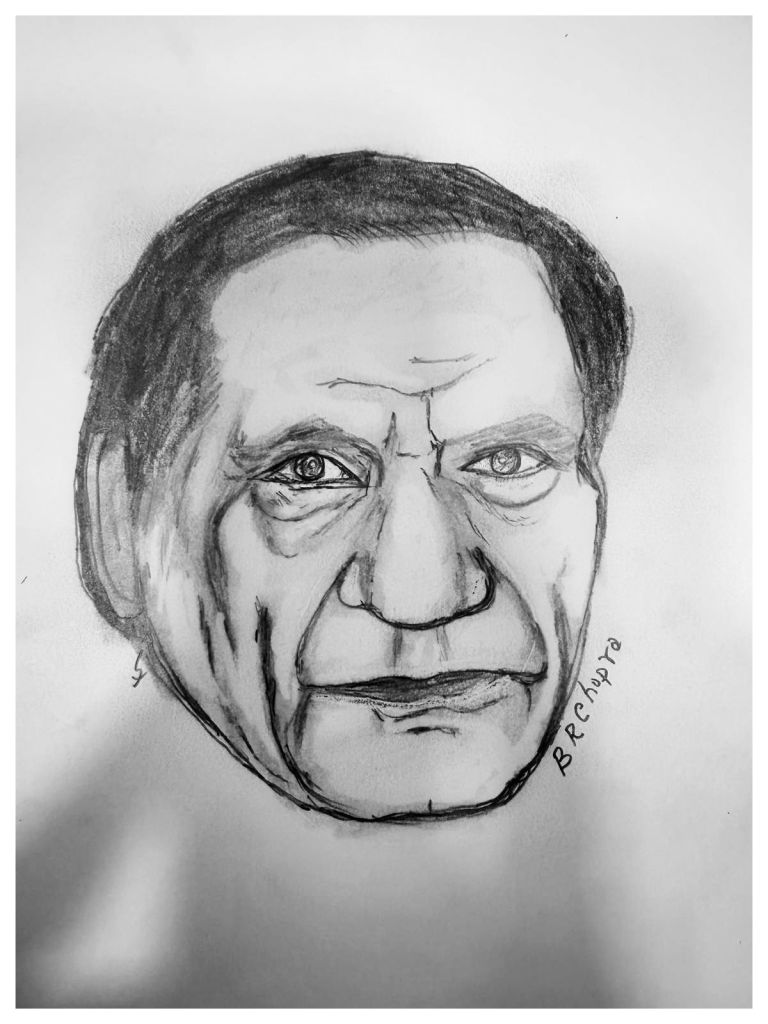
Then again when you see the result, no one cares about the journey which is actually really important! Of course for people like B R Chopra with the magnum opus Mahabharata; his journey and the final result will be remembered for a long time!
SHubh ratri…
 ramadocblog