Years back when we used to see our professor try to put the small Piston in that little ‘Hole’, we used to think, “Why is he taking so much time!?”. Then when we started doing the same procedure; we finally got it!
Trying to do that with one hand holding the endoscope and then slowly placing that almost microscopic piston into the correct position, I would not have been surprised that any junior watching would have also thought the same thing!
That is when you must think about Dunning-Kruger effect!
But (he he!); before that you must know about; Déformation professionnelle (French: [defɔʁmasjɔ̃ pʁɔfɛsjɔnɛl], professional deformation or job conditioning! Now this is a tendency to look at things from the point of view of one’s own profession or special expertise, rather than from a broader or humane perspective. The implication is that professional training, and its related socialization, often result in a distortion of the way one views the world.
This is basically a cognitive bias that restricts a designer’s view of the world. Where most people will see things from a more general point of view, designers—and other specialists, for that matter—run the risk of sticking only to the views offered by the lens of their expertise. Being so biased by their professional backgrounds can trap designers and ‘experts’ into limited viewpoints, and they may therefore overlook vital points about a design problem or proposed solution. This of course is a symptom of “over-specialization” in one field.
A corollary to this is the Dunning-Kruger effect!
Now this is a cognitive bias that occurs when someone overestimates their knowledge and abilities. It was first coined by David Dunning and Justin Kruger, both psychologists at Cornell University, in their 1999 paper.
The psychologists conducted four different studies that each tested participants on humor, grammar, and logic. Participants weren’t just evaluated – they were also asked to predict their own performance. The participants who scored in the bottom quartile of the tests had grossly overestimated their own abilities. Their actual performance, on average, put them in the 12th percentile, despite the fact they self-estimated they’d be closer to the 62nd percentile.
In case that stumped you; think of the typical ‘dad’ who does not ask for directions on a road trip and gets the family lost or who sees a video on making a birdhouse or shelf in the Television and ends up with a shelf made in a quake! In this case he or she for that matter grossly overestimate his or her competence!
It is like how many ‘uncles’ sit on the couch while watching the cricket or any other game and give ‘professional’ opinions on how to play the game! Of course sometimes it may be right but exceptions are not examples!
Now if you think that the above implies that the Dunning-Kruger effect relates to basic intelligence and only happens to the most bumbling and inept among then you are wrong! In reality, the Dunning-Kruger effect can happen to all of us!
So decisions and work in an average life must have a balance between Déformation professionnelle and the Dunning-Kruger effect! Then it should be ok!
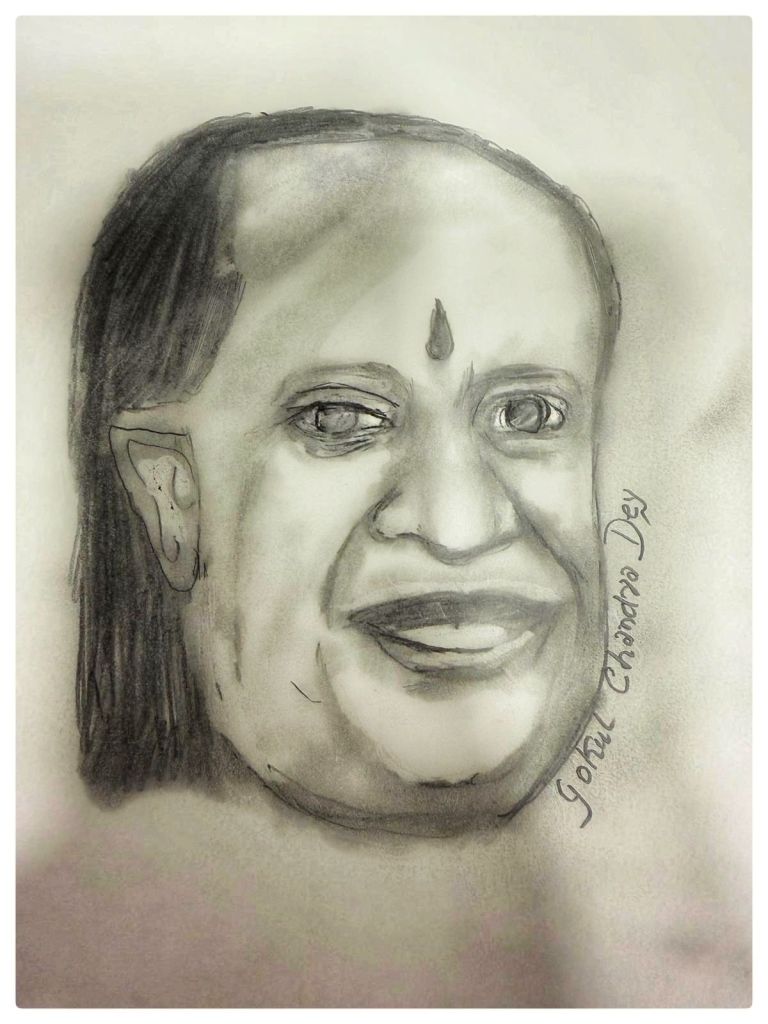
Of course some people like padma awardee Gokul Chandra dey are the real deal!
Read about him!
Shubh Ratri!
 ramadocblog