“He or she will make you sleep!
It is necessary so you do not weep!
Do not fret! He or she is always on call!
‘Cause them anesthetists, are da best of ’em all!”
In our medical college and even in the post graduation period some surgeries were tricky! And the most important person who was needed had come from a line of ‘experts’ who used to give opium to patients!
Then again one of them in that very line was the first doctor to be celebrated by a doctor’s day!
Intrigued!?
Read on!
So when we used to have a case which is specially tricky or needs some good control of pain and more cooperation; the only specialist we needed were the anesthetists!
There were days marked for them and they would leave soon after! Though we have many times even done surgeries like tonsillectomy and Thyroid surgery in local anesthesia; many cases need General Anesthesia!
Also when the anesthetist is involved then the surgeon’s stress and pressure is reduced! He or she would keep everything ready and we could simply do the job!
The amount of knowledge and composure needed to be an anesthetist cannot be told enough! Especially when there is some complication or the dreaded ‘Patient not waking up!’.
Though they would be sitting on the sides with a paper on hand or may be a coffee mug, am sure that the mind and focus would be on the patient!
Now of course we have amazing drugs and medications which can control almost all aspects of anesthesia like heart rate and sedation; one of the first ‘anesthetic agent’ was actually opium and its analogues!
Am sure many would agree for a surgery if the offer stil stands now!
While the use of opium poppy and other herbal remedies as anesthetics date back to early civilization, the first public demonstration of modern anesthesia was on October 16, 1846 (“Ether Day”). William T. G. Morton and surgeon John Collins Warren made anesthesia history at Massachusetts General Hospital with the successful use of diethyl ether “anaesthesia” to prevent pain during surgery.
Since this historic milestone, advancements in anesthesia administration and newer anesthetics led to the medical specialty of anesthesiology in the early 20th century
The early history reveals that Babylonians relieve toothache with henbane (Hyoscyamus niger) and acupuncture is being practiced in China, according to Shang Dynasty pictographs on bones and turtle shells maybe some of the local anesthesia techniques.
Our own Sushruta uses cannabis vapors to sedate surgical patients. Over ensuing centuries, other herbs like aconitum would supplement that sedation in India and eventually in China.
German physician and botanist Valerius Cordus (1515–1544), synthesizes diethyl ether by distilling ethanol and sulphuric acid into what he called “sweet oil of vitriol.” This was a major step in future anesthesia though it would be used only three hundred years or so later officially!
Joseph Priestley (1733–1804)—English chemist and natural philosopher, discovers “airs” of oxygen and nitrous oxide; the first to isolate oxygen. This was also essential since when the patient is unconscious, we have to pump oxygen.
Humphry Davy in his Researches observed that “As nitrous oxide in its extensive operation appears capable of destroying physical pain, it may probably be used with advantage during surgical operations in which no great effusion of blood takes place.”
William Clarke (1819‐1908)—In Rochester, New York, a medical student etherizes a single patient for a dental extraction! This may be one of the first time it had been used like this but it was not ‘official’
Subsequently Dr. Crawford W. Long (1815-1878) etherizes James Venable for removal of neck cysts on March 30, 1842. Dr. Long would become honored as the 1st anesthesiologist on a US Postage stamp (1940) and as the inspiration for the 1st “National Doctors Day” on March 30, 1991!
On October 16, 1846 William T. G. Morton (1819-1868) made history by being first in the world to publicly and successfully demonstrate the use of ether anesthesia for surgery.
This occurred at what came to be called “The Ether Dome,” at Massachusetts General Hospital on patient Edward Gilbert Abbott. Surgeon John Collins Warren noted, “Gentlemen, this is no humbug.” Dr. Oliver Wendell Holmes, Sr. (1809-1894)-suggests the terms “anaesthetic” and “anaesthesia” in a letter to William T. G. Morton.
This started the anesthesia revolution and evolution to the advanced science and speciality it is today!
The very act of making someone unconscious and making them non responsive to pain is magical, genius and feels crazy!
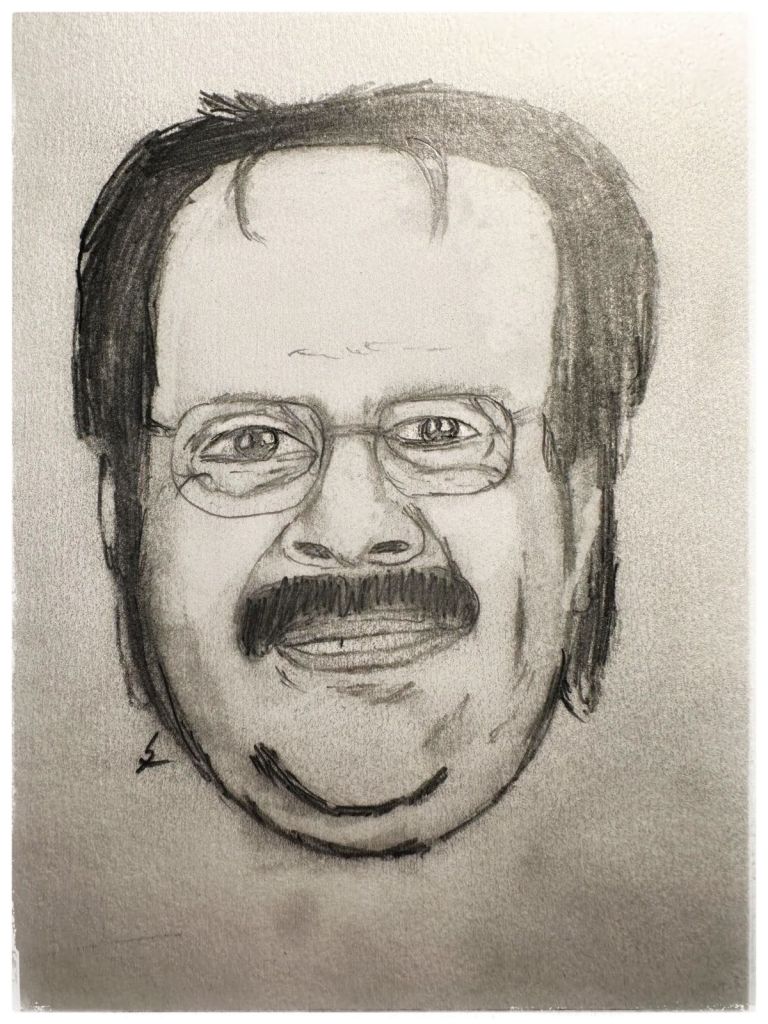
Crazy reminds me of the celebrity of the day, Crazy Mohan!
Sketching a famous anesthetist would have been a tricky affair so I went the surgeon’s safer way!
Wishing all my anesthetists friends and colleagues a very happy anesthetist day!
You are the reason why many patients and surgeons sleep at night! Like you all must do now!
Shubh Ratri!
 ramadocblog