“The shores keep calling me
The sound it makes by the sea!
The ocean so vast and wide
Waves at me with the tide!”
What is the similarity between one of the biggest things you know and one of the smallest ones you know!? Did you also know that these things which you cannot see were described many years ago!? Also you may know this another scientist because of a cat! Triple intrigued!?
read on!
Kaṇāda also known as Ulūka, Kashyapa, Kaṇabhaksha and Kaṇabhuj was an ancient Indian natural scientist and philosopher who founded the Vaisheshika school of Indian philosophy that also represents the earliest Indian physics.
Kaṇāda proposed that paramanu is an indestructible particle of matter. The paramanu is indivisible because it is a state at which no measurement can be attributed. He used invariance arguments to determine properties of the atoms. He also stated that anu can have two states—absolute rest and a state of motion!
Now this will be more clear when you get the english word for paramanu! Yes! Atom!
Now the word atom is derived from the ancient Greek adjective atomos, meaning “uncuttable” or “indivisible.”
We now know that the atom has a nucleus composed of protons and neutrons surrounded by clouds of electrons. The protons are positively charged, electrons are negatively charged, and neutrons possess no charge!
In one of the models of the atom which is called the Rutherford model; The atom is described as a tiny, dense, positively charged core called a nucleus, in which nearly all the mass is concentrated, around which the light, negative constituents, called electrons, circulate at some distance!
There is another much bigger system in which the mass is concentrated in the center and other lesser mass go ‘around’ or move in a cyclical way around the central mass! Yes! The solar system!
This was of course an oversimplification of the structure of atom which has now been superseded by “The Quantum Mechanical Model” which views electrons within an atom as waves, not as particles as previously believed. Because of this, electrons can be described as having a high probability of residing in specific orbitals, or regions of space, within the atom!
There was this comment that if you cannot explain something to a five year old then it means that you have not understood it yourself! The Rutherford model is the simple version while the Quantum mechanical model is the uber complex model!
The quantum model is a modification of two other models called the Bohr’s and this another one you would have heard in association with a cat!
This scientist solved a series of mathematical equations to come up with a model for the distributions of electrons in an atom! His model shows the nucleus surrounded by clouds of electron density. These clouds are clouds of probability; though we don’t know exactly where the electrons are, we know they’re likely to be found in given regions of space. These regions of space are referred to as electron orbitals!
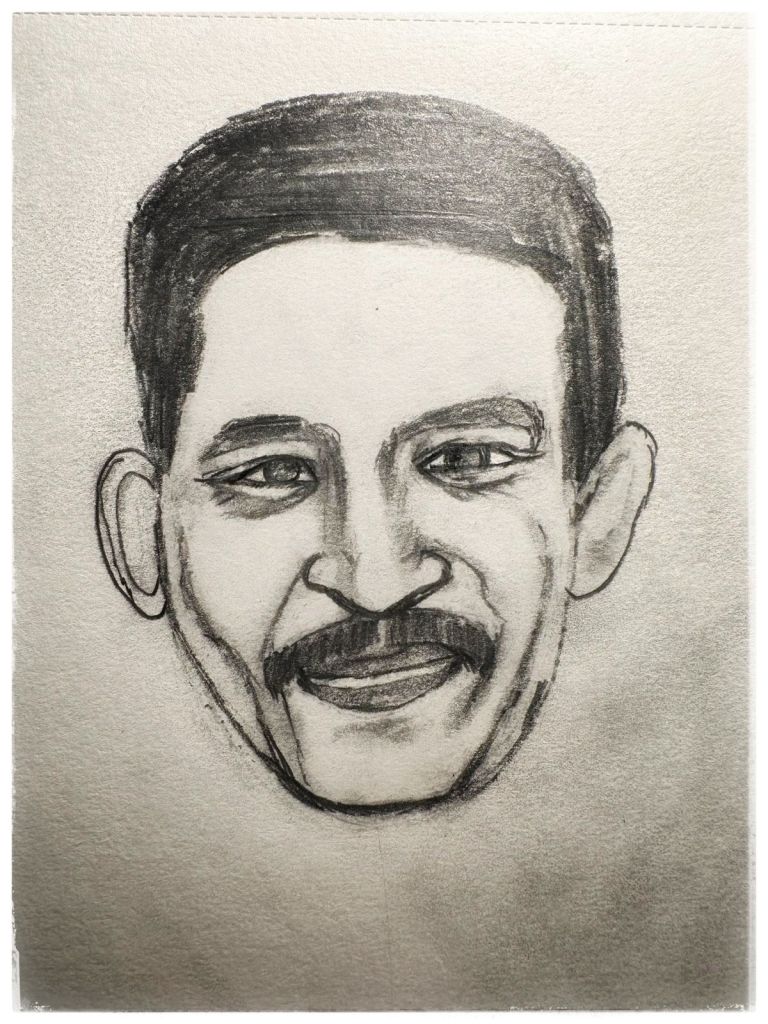
Saw the uncertainty? Well doesn’t it remind you of a scientist and the cat!? Well! Even this model is by the same person! Schrödinger! Of course the cat story is for another day! or is it!? The reason why Rutherford model is comfortable is because of its similarity to the Solar system! This familiarity gives a sense of security or contentment! We are always wary of those which are not familiar! Now the sketch of birthday celebrity Atul Kulkarni was tolerable to my son since he was a familiar face in a movie we had seen recently! Oh all right, the movie was The Ghazi attack!
Lets now respect the solar system and sleep!
Shubh Ratri!
 ramadocblog